

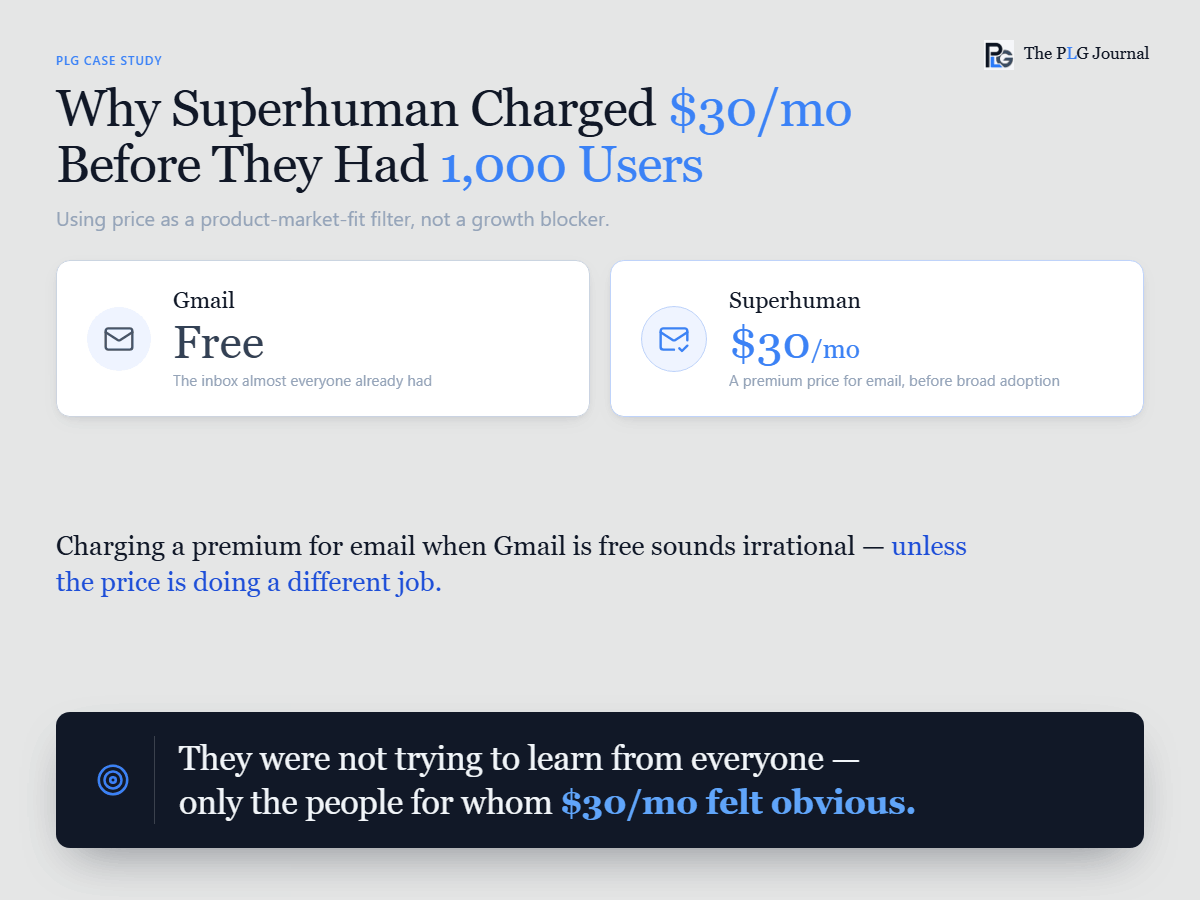
Superhuman charged $30/month for email when Gmail was free.
That sounds irrational at first. Email is one of the most commoditized software categories in the world. Most people already had access to Gmail, Outlook, Apple Mail, or another inbox that technically worked well enough.
So why would a startup charge a premium price for an email client before it had broad adoption?
Because Superhuman was not trying to learn from everyone.
They were trying to find the people whose email problem was painful enough that $30/month felt obvious.
That distinction is the real lesson.
Most early-stage product teams think of price as a growth blocker. The instinct is to reduce friction, get as many users as possible into the product, watch the data, and figure out monetization later.
Superhuman took a different path. The company used price, scarcity, and hands-on onboarding to narrow the learning environment. Instead of optimizing for the most users, they optimized for the clearest signal.
That is one of the most underrated product-led growth lessons from Superhuman: sometimes friction does not slow learning down. Sometimes it improves the quality of what you learn.
Superhuman was not built for “people who use email”
The obvious mistake with a product like Superhuman would have been defining the market too broadly.
Almost everyone uses email. That does not mean everyone has the same email problem.
For many people, email is a utility. They check it a few times per day, respond when needed, and tolerate the inbox because it is not central enough to justify paying for a better experience.
For others, email is the operating system of their work. Salespeople, founders, executives, investors, recruiters, customer-facing leaders, and operators may spend hours per day in their inbox. Responsiveness affects reputation. Speed affects throughput. Inbox management affects stress, focus, and execution.
Superhuman was built for that second group.
The product was not positioned as a slightly nicer Gmail interface. It was positioned as the fastest email experience in the world. The promise was not cosmetic. It was about moving through email dramatically faster, staying responsive, and feeling in control of a workflow that had become overwhelming.
That focus mattered because product-market fit is rarely found by averaging the needs of a broad audience.
If Superhuman had launched the product widely and made it free, the company might have attracted many casual users. Some would have wanted a better-looking inbox. Some would have been curious about the hype. Some would have signed up because it was free, then quietly churned.
That might have produced more data.
But not necessarily better data.
Early product discovery is not just about volume. It is about learning from the people who feel the problem intensely enough to change their behavior.
Price as a filter, not a wall
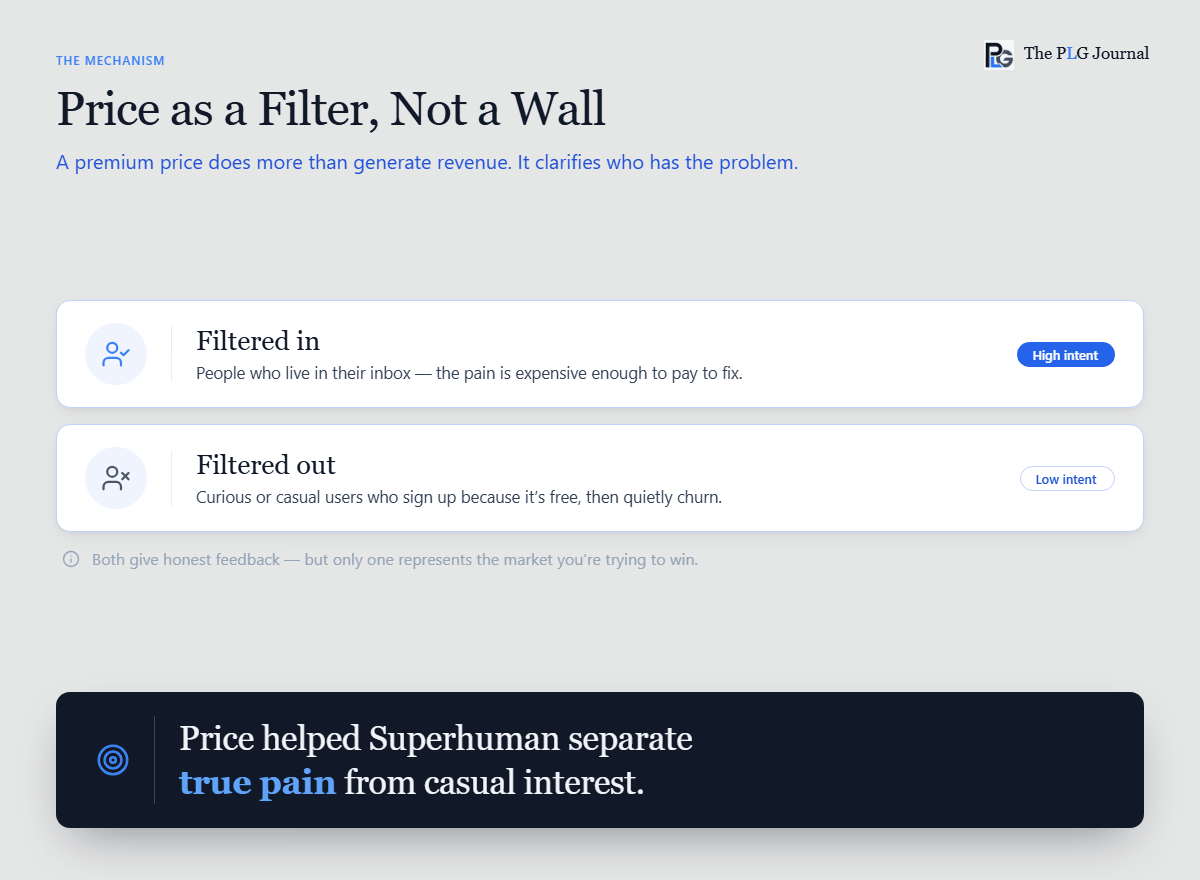
Charging $30/month did more than generate revenue. It clarified who had the problem.
A user willing to pay for email when free alternatives exist is sending a very specific signal. They are not merely curious. They believe the pain is expensive enough to justify paying for a better way to work.
That does not mean every early-stage company should charge more. It means price can be used as a discovery mechanism.
Superhuman’s price filtered in people who lived in their inbox and filtered out people who were only casually interested. That made the feedback sharper. It helped the team focus on users whose needs were extreme enough to reveal what the product had to become.
This is important because not all feedback is equally valuable.
A casual user might ask for broader customization, more integrations, a cheaper plan, or features that make the product feel more familiar. A high-intensity user may care far more about keyboard shortcuts, speed, search, triage, follow-up, offline performance, and shaving seconds off repeated workflows.
Both users are giving honest feedback, but only one may represent the market the company is trying to win. Price helped Superhuman distinguish true pain from casual interest.
The hidden cost of free users
Free users are not bad. Many of the best product-led companies use free plans effectively.
The mistake is assuming free access always produces better learning.
In the earliest stages, free access can flood a product with users who do not resemble the eventual best customers. The team then has to interpret noisy behavior from people who may never pay, never activate deeply, and never care enough to provide high-quality feedback.
That can distort the roadmap.
The company sees more sign-ups and more usage, but the product team starts optimizing for the average user rather than the most valuable segment. Features become broader. Positioning becomes softer. Onboarding becomes more generic. The product starts to serve curiosity rather than intensity.
This is especially dangerous before product-market fit is achieved.
At that stage, the company is not trying to maximize top-of-funnel volume. It is trying to answer a sharper question: Who needs this badly enough to be genuinely disappointed if it disappeared?
Superhuman made that question explicit.
Measuring product-market fit instead of guessing
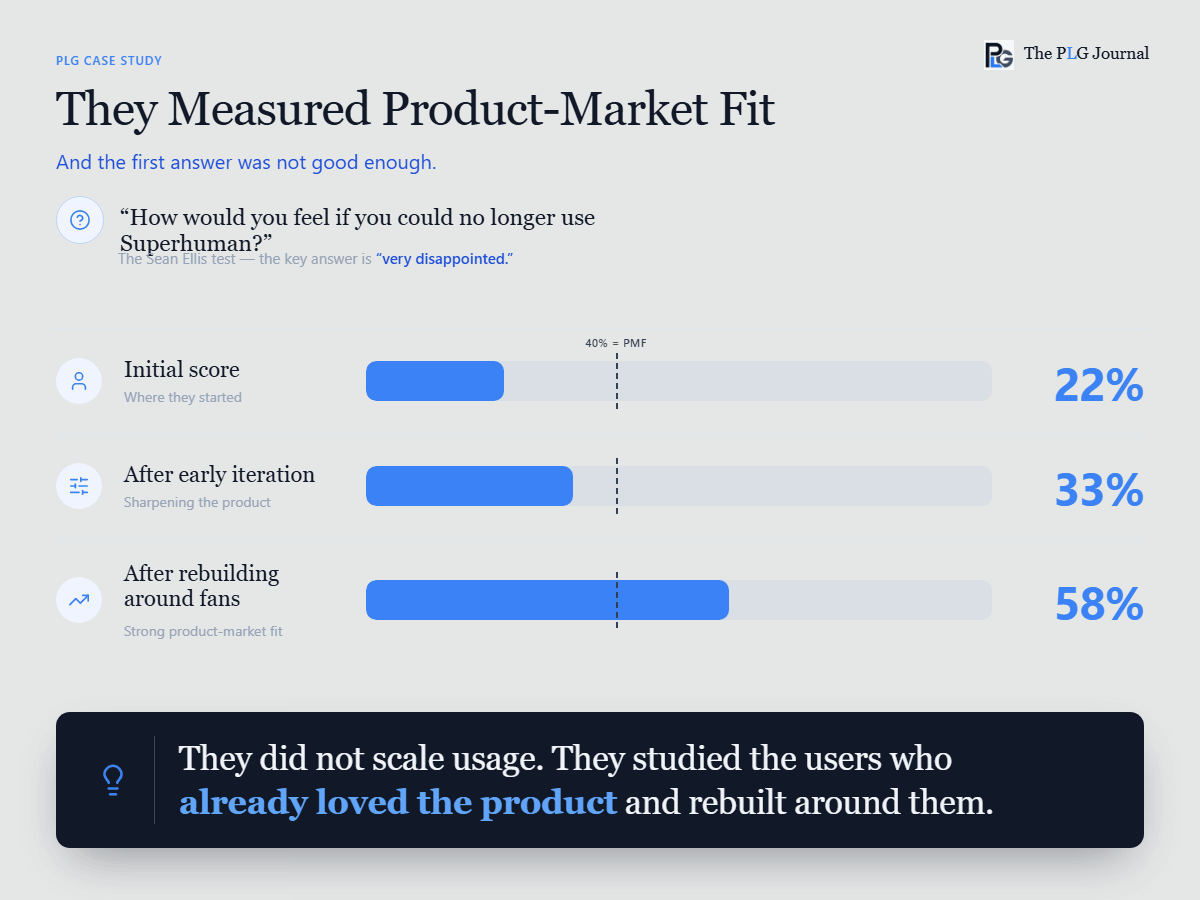
Rahul Vohra popularized Superhuman’s product-market-fit approach with a simple survey question: “How would you feel if you could no longer use Superhuman?”
The key response was “very disappointed.”
Their benchmark was that if at least 40% of users felt this way, it indicated a strong product-market fit. Initially, only 22% of users said they would be very disappointed, which wasn't enough.
Instead of pushing for broader growth or acquiring more users, Superhuman analyzed responses by focusing on users who loved the product. They identified what differentiated these users and adjusted their roadmap to increase this loyal segment.
As a result, the score rose from 22% to 33%, then to 58%. This approach shifts the focus from simply attracting more users to making the right users deeply love the product, marking a shift from growth hype to genuine product-market fit.
Why was product-led growth
At first glance, Superhuman may not appear to be a typical PLG company. Its invite-only system, premium pricing, high-touch onboarding, and deliberate access limitations stand in contrast to the common PLG model of free signups, instant access, self-serve onboarding, and rapid viral growth.
However, product-led growth is not about removing all barriers; it’s about leveraging the product experience as the main driver of acquisition, activation, retention, and expansion.
For Superhuman, the product experience itself was the strategy—using pricing to filter for committed users, a waitlist to create scarcity and assess demand, and onboarding to understand each user’s email workflow. This enabled the team to deliver a highly tailored experience to those most likely to value it.
This highlights an essential lesson for product leaders: PLG does not always mean “make it free and open to everyone." Sometimes, a constrained system that fosters high-quality learning, intense adoption, and positive word-of-mouth among the right users is the most effective approach.
A low-friction funnel works well when the product already has a clear activation path and a broad self-service market, but excessive early access can become a liability.
Friction can improve the signal
Most product teams aim to eliminate friction. This is generally correct once the team understands the target user, what activation entails, and which behaviors promote retention.
However, in early stages, some friction can be beneficial. The key is whether the friction hinders value or clarifies intent. Poor friction blocks the right customers from accessing value, such as confusing onboarding, excessive form fields, unclear pricing, slow performance, broken workflows, or requiring a sales call for simple cases.
Conversely, good friction filters for intensity, commitment, or fit include a premium price, an application process, use-case selection, a setup call, qualification questions, or real data entry. For instance, Superhuman’s $30/month fee was not arbitrary; it indicated whether email speed and focus were valuable enough for a segment to pay for.
The aim isn’t to add friction unnecessarily but to distinguish barriers that provide learning from those that hinder product adoption. A simple test: if removing friction attracts the right users, do it. If it brings many users who dilute learning, expand the roadmap, or are rarely retained, proceed cautiously.
The Product-Led Filter Framework
Superhuman’s approach can be adapted into a practical framework for founders and product leaders. When developing a product prior to achieving clear product-market fit, the focus should not be on maximizing user count.
Instead, the priority is to enhance the quality of the learning loop. A helpful filter should help answer four key questions.
1. Who feels the pain most intensely?
Start by identifying the users for whom the problem is not occasional or mildly annoying but frequent, expensive, visible, or emotionally frustrating.
For Superhuman, this was the person whose inbox shaped their workday. They were not looking for a prettier email client. They wanted speed, control, and confidence.
In another product, this might be the finance team closing books every month, the support manager drowning in tickets, the developer responsible for production reliability, or the product leader who needs faster customer feedback loops.
The early question is not “Who could use this?”
It is: “Who feels this problem so often that they are actively looking for a better way?”
2. What behavior proves they care?
Interest is cheap. Behavior is more useful.
A user saying “this sounds cool” is not the same as joining a waitlist, paying early, importing data, inviting a team, completing setup, or changing a workflow.
Superhuman used price as one signal of seriousness. Other products may use different signals.
For a developer tool, the signal might be integrated into a real environment. For an analytics product, it might be connecting to production data. As a collaboration tool, it might invite active teammates. For an AI product, it might be using the output in a real workflow rather than generating a novelty demo.
The signal should require sufficient effort that casual users are less likely to complete it.
3. What feedback should shape the roadmap?
Not every user should have equal influence over the product.
The most useful feedback often comes from users who match the target segment, experience the pain frequently, and would be genuinely disappointed if the product disappeared.
Superhuman did not simply average all feedback. The team studied the users who loved the product most and asked what made them different.
Segment feedback by intensity.
Which users are paying? Which users are activating deeply? Which users are retained? Which users would be very disappointed if they didn't have the product? Which users are bringing the product into their real workflow?
Those users should carry more weight in roadmap decisions than casual users who may never become the core market.
4. When should friction be removed?
Friction generally should decrease as confidence in the product grows. Initially, price points, qualification processes, manual onboarding, or waitlists help the team identify the right customers.
However, once the product has a well-defined ICP, an established activation process, and strong retention rates, any unnecessary friction should be eliminated.
The order of these steps is important. First, apply filters to target the appropriate users. Next, utilize their behavior and feedback to refine the product. Finally, reduce friction to facilitate growth.
Many companies reverse this sequence, lowering friction early to attract a wide audience, but then face challenges in understanding why retention is low. The key lesson from Superhuman is to avoid scaling without clarity and focus
When price can help product discovery
Price is not always the right filter, but it can be powerful when the product solves a problem with clear economic or professional value.
It works especially well when:
The problem is frequent
The pain is intense
The user has a budget or personal willingness to pay
The product promises time savings, revenue impact, risk reduction, or status improvement
Free alternatives exist but are meaningfully worse for the target user
The company needs sharper feedback from serious users
Superhuman fits this pattern. Gmail was free, but for the target user, the cost of a slow inbox was not zero. The cost showed up as lost time, missed follow-ups, slower responses, and cognitive drag.
A $30/month price can feel expensive to a casual email user and cheap to someone who spends several hours per day in email. That gap is the filter.
The same principle applies elsewhere.
A founder might not pay for another generic note-taking app. But they may pay for a tool that helps them prepare investor updates faster.
A support leader might not pay for another dashboard. But they may pay for a product that reduces escalations or improves response quality.
A product manager might not pay for another survey tool. But they may pay for something that helps them identify churn risk before the next roadmap cycle.
The price is not just capturing willingness to pay. It is revealing how costly the problem already feels.
When price becomes the wrong filter
The lesson is not “charge early no matter what.”
Price can hurt discovery by filtering out exactly the users you need to learn from.
If the product depends on network effects, a high price may prevent the system from forming. If the buyer and the user are different people, early pricing may prevent the user from realizing value. If the category requires education, the price may add friction before the customer understands the problem. If the target market lacks budget, willingness to pay may be a poor proxy for pain.
Price also works poorly when the product’s primary challenge is not intensity but accessibility.
For example, a team collaboration product may need multiple people inside an account before value appears. A marketplace may need liquidity before either side experiences the product. A consumer social product may need density and habit before monetization makes sense.
In those cases, another filter may work better. The filter could be use case, company size, role, workflow maturity, data quality, team participation, or willingness to complete setup.
The main idea is not that price is always the ideal filter; rather, early growth should be deliberately filtered.
Better filters create better learning
Every early-stage product has filters, whether the team admits it or not.
Positioning filters that pay attention. Onboarding filters out those who do not find the value. Pricing filters for those who commit. The feature set filters who stays. The sales motion filters who gets access. The product experience filters who returns.
The only question is whether those filters are intentional. Superhuman made the filters explicit.
A premium price signaled that the product was for professionals who deeply valued email speed. The invite-only model gave the team control over who entered the learning loop. Manual onboarding helped the team understand user workflows. The PMF survey identified which users truly loved the product.
Together, those filters created a higher-quality signal.
This is the part many teams miss. Product-led growth is not only about reducing friction. It is about designing the path to value so the right customers can reveal themselves, activate, and expand.
More users are only beneficial if they enhance the learning system; otherwise, growth can introduce noise.
How product teams can apply this
For founders and product leaders, the key point isn't to imitate Superhuman’s $30/month pricing. Instead, focus on creating your own product-led filtering approach. Here's a straightforward process to do so.
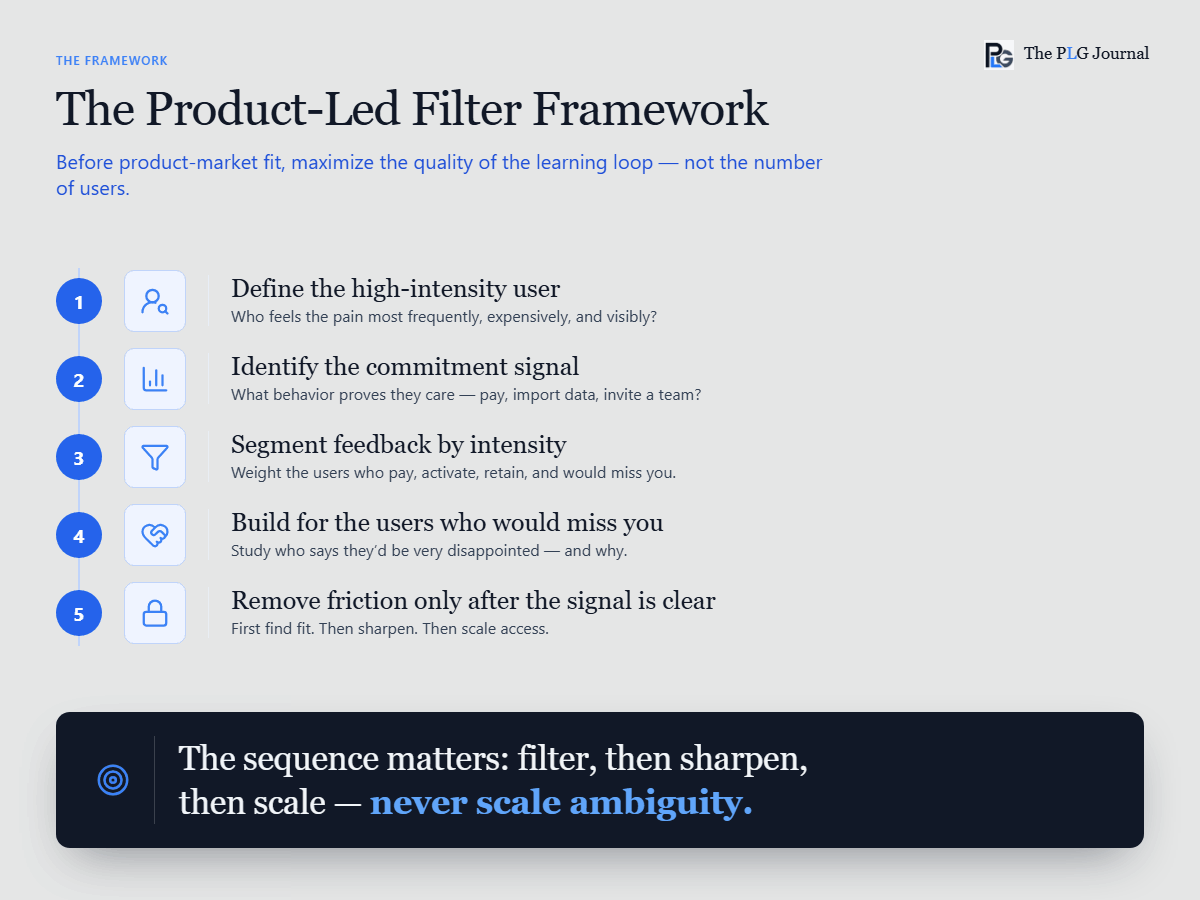
Step 1: Define the high-intensity user
Write down the user segment that feels the problem most frequently and painfully.
Avoid broad descriptions like “teams that use email,” “companies that need analytics,” or “people who create content.”
Get specific.
For Superhuman, the valuable segment was not everyone with an inbox. It was people whose professional effectiveness depended on getting through email quickly.
Step 2: Identify the commitment signal
Decide what behavior proves the user cares.
That could be payment, waitlist completion, connecting real data, inviting teammates, importing workflows, completing setup, attending onboarding, or using the product in a live business process.
The signal should separate serious users from casual users.
Step 3: Segment feedback by intensity
Do not treat every piece of feedback equally.
Separate users by behavior:
Who paid?
Who activated?
Who retained?
Who uses the product frequently?
Who would be very disappointed without it?
Who fits the ICP?
Who referred others or brought the product into a real workflow?
Then prioritize learning from the users who show the strongest evidence of pain and fit.
Step 4: Build for the users who would miss you
Use the Superhuman-style PMF question:
“How would you feel if you could no longer use this product?”
Study the users who say they would be very disappointed.
What role are they in? What problem are they solving? What feature do they value most? What alternative would they use? What words do they use to describe the product?
This is where positioning, roadmap, onboarding, and messaging should come from.
Step 5: Remove friction only after the signal is clear
Once you understand your target users and what encourages activation, focus on eliminating obstacles. Simplify the onboarding process, incorporate self-serve options, consider lower-priced plans where suitable, automate setup, expand acquisition efforts, and enhance lifecycle messaging.
However, only do these after you've identified what to scale. Removing barriers prematurely might give a false sense of progress but can make the product more difficult to prioritize and improve.
The real lesson from Superhuman
Superhuman’s $30/month fee wasn't just about making money; it served as a tool for product discovery. It revealed who genuinely felt the problem, who valued the product enough to pay, and whose feedback should influence the product roadmap.
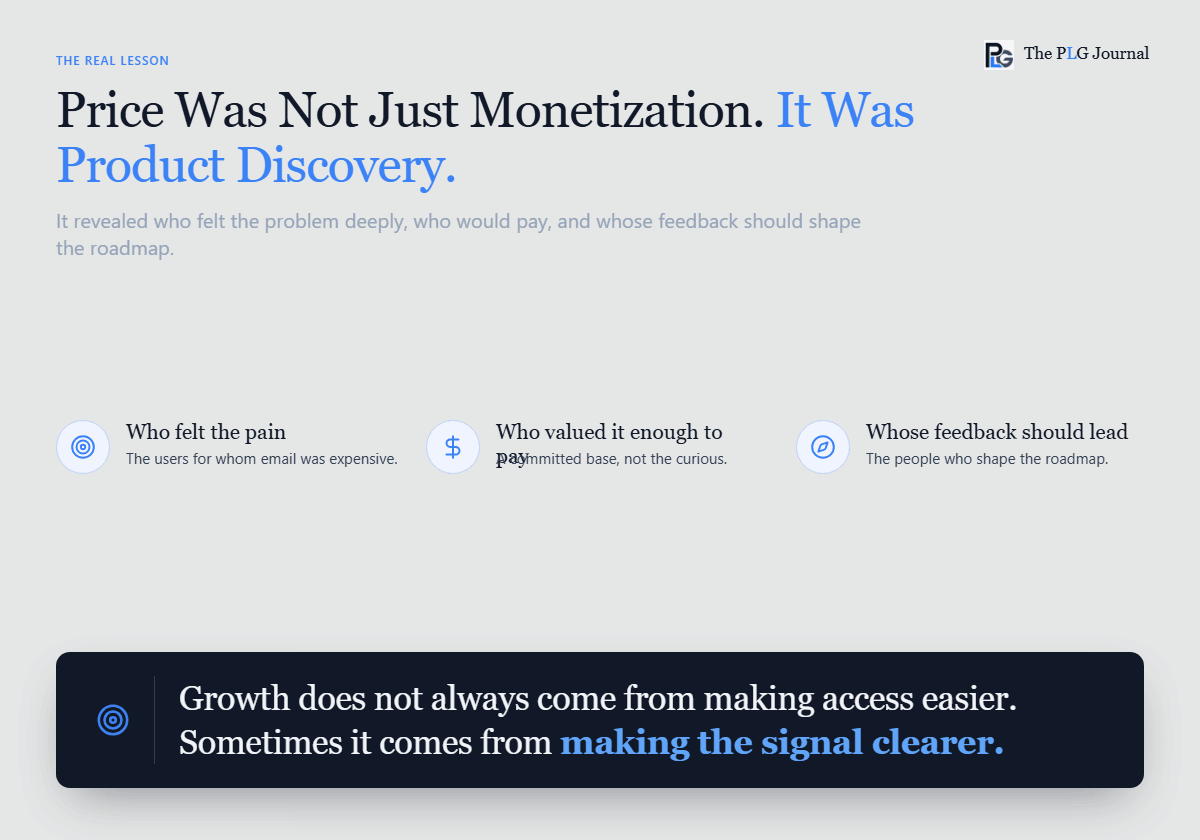
This exemplifies a broader PLG (product-led growth) lesson: growth isn't always about lowering access barriers. Sometimes, clarifying the signal is more effective. Before reaching product-market fit, increasing users can introduce more noise, generate more confusing feedback, and lead to sign-ups that attract the average user rather than the ideal one.
For early product-led companies, the goal isn't to eliminate all barriers but to identify which barriers hinder value and which indicate fit. Superhuman used price as a strategic lens to identify who the product was truly for. With this understanding, the team could focus on building with greater accuracy.