

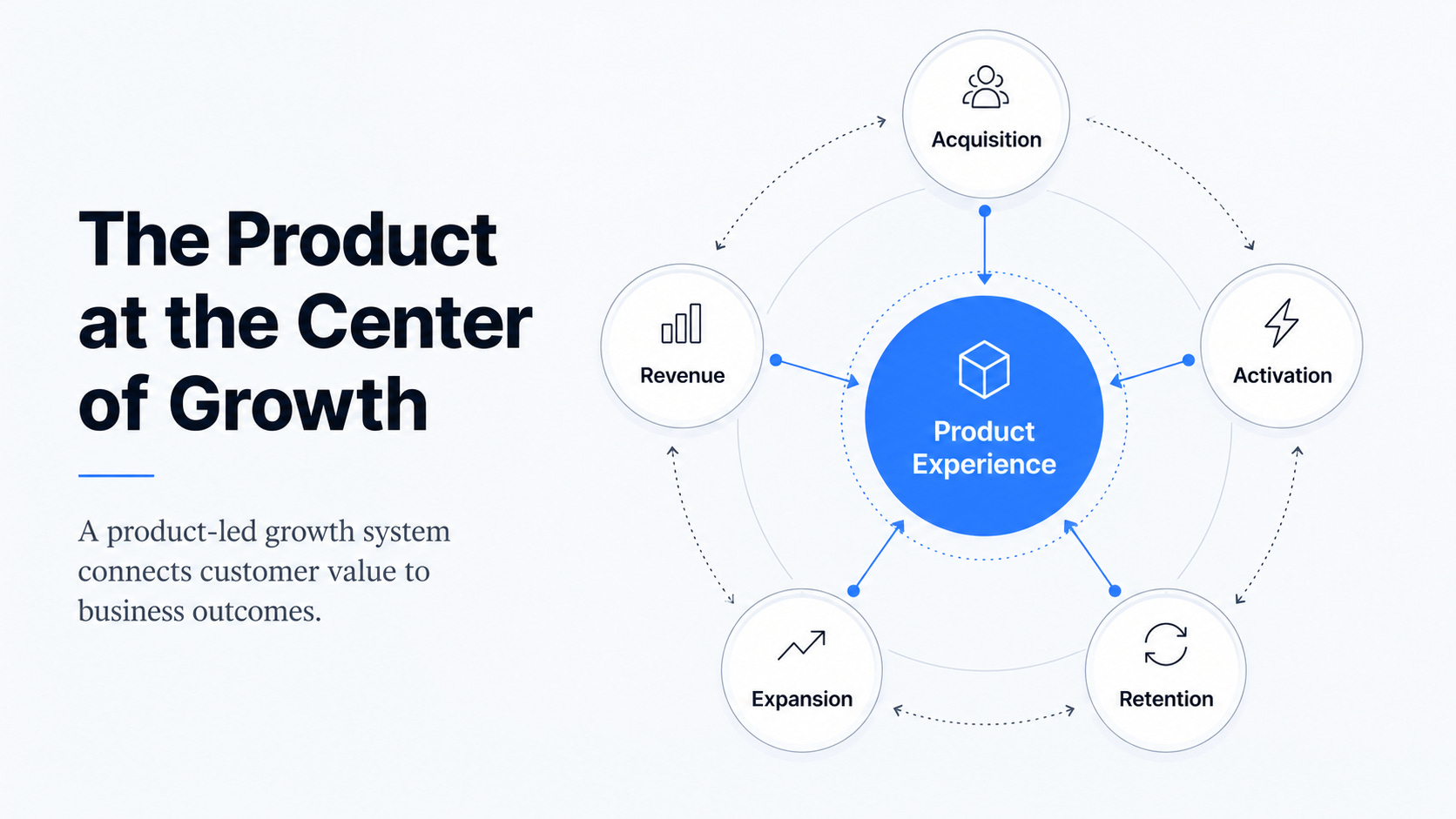
Product-led growth has become one of the most useful ideas in modern product strategy, but also one of the easiest to misunderstand.
Most companies are drawn to PLG for the outcomes it offers: lower acquisition costs, faster activation, better retention, more efficient expansion, stronger product data, and a more scalable growth motion. Those outcomes are real, but they do not come from adding a free trial, opening up self-serve signup, or putting a few usage metrics in a dashboard.
Those are mechanisms. They are not the strategy.
At its core, product-led growth means the product itself plays a central role in how customers discover, evaluate, adopt, retain, and expand their relationship with the company. The product is not simply what gets delivered after a sale. It becomes part of the growth system.
That distinction matters because it changes how leaders should think about the work.
A company does not become product-led because users can sign up without talking to sales. It becomes product-led when the product can help the right customer understand the value, experience that value, repeat that value, and eventually expand that value with less dependency on the organization forcing every step from the outside.
This is why PLG is both powerful and difficult. It requires more than a better onboarding flow or a more generous free plan. It requires the product experience, customer journey, data model, pricing, packaging, sales motion, customer success model, and operating rhythm to be aligned around customer value.
That is the standard.
PLG begins with value, not acquisition
The most common mistake companies make with PLG is starting with the top of the funnel.
They ask how to drive more signups, increase trial starts, shorten onboarding, or generate more product-qualified leads. Those questions can be useful, but they are not the starting point. A product-led strategy begins with a more fundamental question: what value can the customer experience directly through the product?
Until that is clear, every growth tactic is downstream of uncertainty.
A high-volume signup motion does not matter if users do not reach value. A beautiful onboarding flow does not matter if it teaches the interface but fails to create progress. Product analytics do not matter if the company cannot distinguish activity from meaningful adoption.
This is where PLG forces better product thinking. It requires a team to define what value actually means in behavioral terms. Not what the company believes is valuable, not what the landing page promises, and not what the roadmap assumes. The question is what customers do when the product is working for them.
For some products, value appears when a user completes a task faster than before. For others, it appears when a team collaborates in a shared workspace, when data becomes easier to act on, when a workflow becomes repeatable, or when a customer sees a measurable business outcome. The shape of value differs by product, but the principle is consistent: PLG only works when the customer can experience enough value to continue.
This is why activation is one of the most important concepts in product-led growth.
Activation is not signup. It is not an account creation. It is not finishing an onboarding checklist. Activation is the point where the customer has experienced enough meaningful value to believe the product is worth using again.
That belief is the foundation of product-led growth.
What PLG is
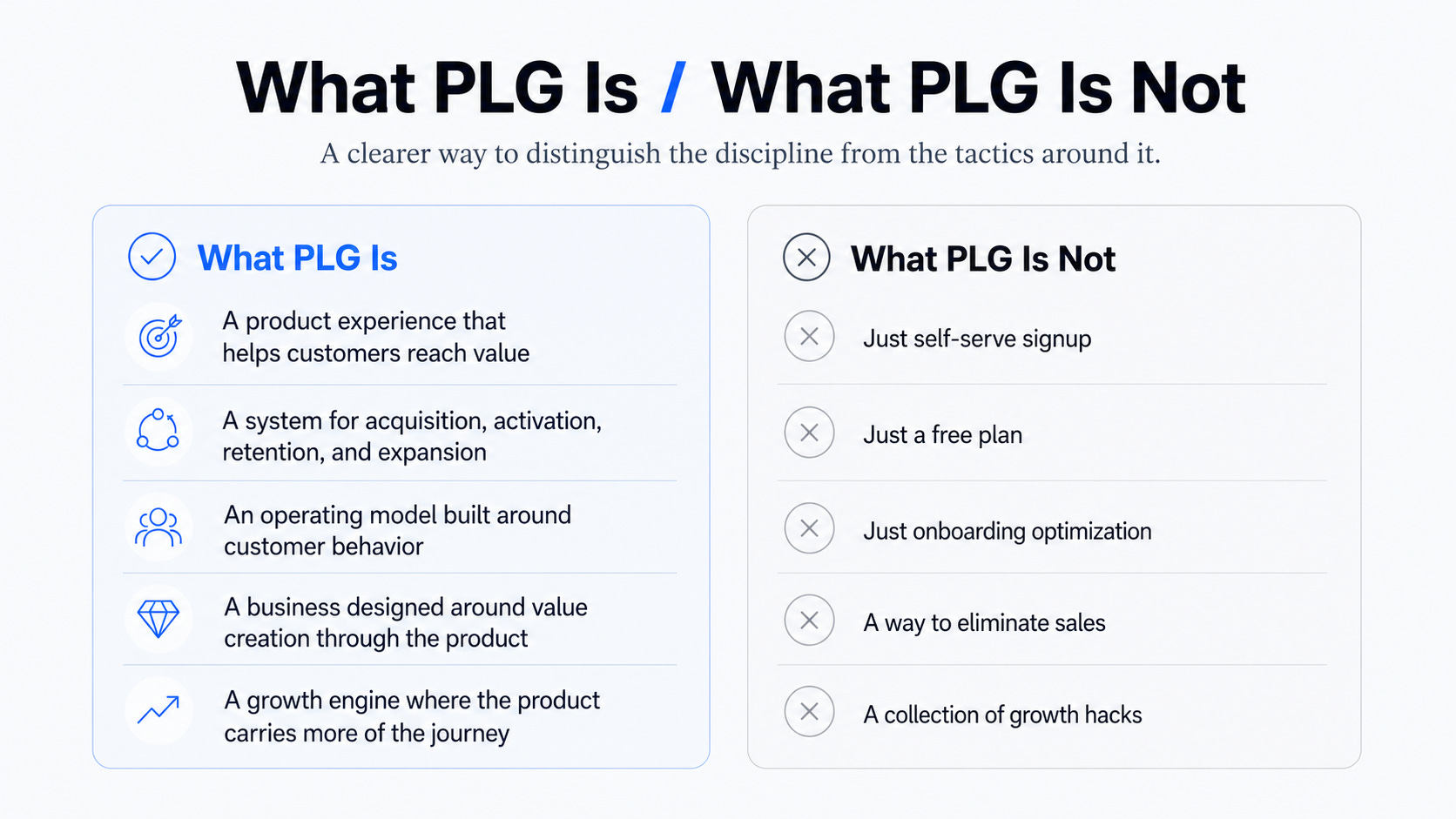
Product-led growth is an operating discipline in which the product experience is designed to create and expand customer value while also driving business growth.
That definition has several implications.
First, PLG is a product strategy, not just a go-to-market motion. The product needs to make value easier to understand, experience, and repeat. This affects the roadmap, the onboarding model, the activation path, the data strategy, and the way teams prioritize work.
Second, PLG is a customer journey strategy. The product needs to carry more of the journey from awareness to adoption to retention to expansion. That does not mean every customer will be fully self-serve. It means the product should reduce ambiguity, build confidence, create evidence of value, and generate signals that other teams can use.
Third, PLG is a business model strategy. Pricing and packaging have to reinforce the way customers experience value. If the packaging blocks the natural path to value, the product-led motion will struggle. If the free or trial experience attracts the wrong audience, the company may create activity without creating a durable growth engine.
Fourth, PLG is an operating model. Product, growth, marketing, sales, customer success, data, and finance all influence whether the system works. Product is central, but product cannot own PLG alone.
This is one of the reasons strong PLG companies often look deceptively simple from the outside. The user experience may feel easy, but the operating system behind it is usually sophisticated. The company understands which behaviors matter, where users lose momentum, what predicts retention, when sales should engage, how expansion happens, and which parts of the journey should be handled by the product versus a human team.
That is the real work of PLG.
What PLG is not
PLG is not the same thing as self-serve signup.
Self-serve can reduce friction, but reducing friction is not the same as creating value. If a user can create an account but cannot figure out what to do next, the company has not built a product-led motion. It has simply moved confusion earlier in the journey.
PLG is not the same thing as a free plan.
A free plan can be useful when it exposes the right value to the right customer at the right moment. It can also create noise. If the free experience attracts users who are unlikely to retain, expand, or represent the target customer, the company may end up optimizing for volume instead of quality.
PLG is not onboarding optimization.
Onboarding matters, but onboarding is only one part of the value journey. A company can simplify the first session and still fail to create a reason for the customer to return. The deeper question is whether the product creates a path from the first value to the repeated value.
PLG is not a way to eliminate sales.
This misconception is especially damaging in B2B. Many strong product-led companies still rely on sales, particularly as they move into larger accounts. The difference is that sales enters the conversation with better context. The product has already created usage, internal champions, intent signals, and evidence of value.
In a strong PLG motion, sales are not replaced by the product. Sales become more effective because the product has already done part of the work.
PLG is not growth hacking.
Growth mechanics can amplify value, but they cannot substitute for it. Invitations, referrals, lifecycle prompts, product-qualified lead scoring, and usage-based nudges only compound when they are attached to a product experience customers already find useful.
A collaboration loop works when collaboration makes the product more valuable. A referral loop works when inviting someone improves the user’s outcome. A usage-based expansion motion works when increased usage reflects increased value. Without that foundation, growth mechanics become a source of pressure rather than leverage.
The PLG value journey
A product-led business needs to understand the journey from first interest to expanded value.
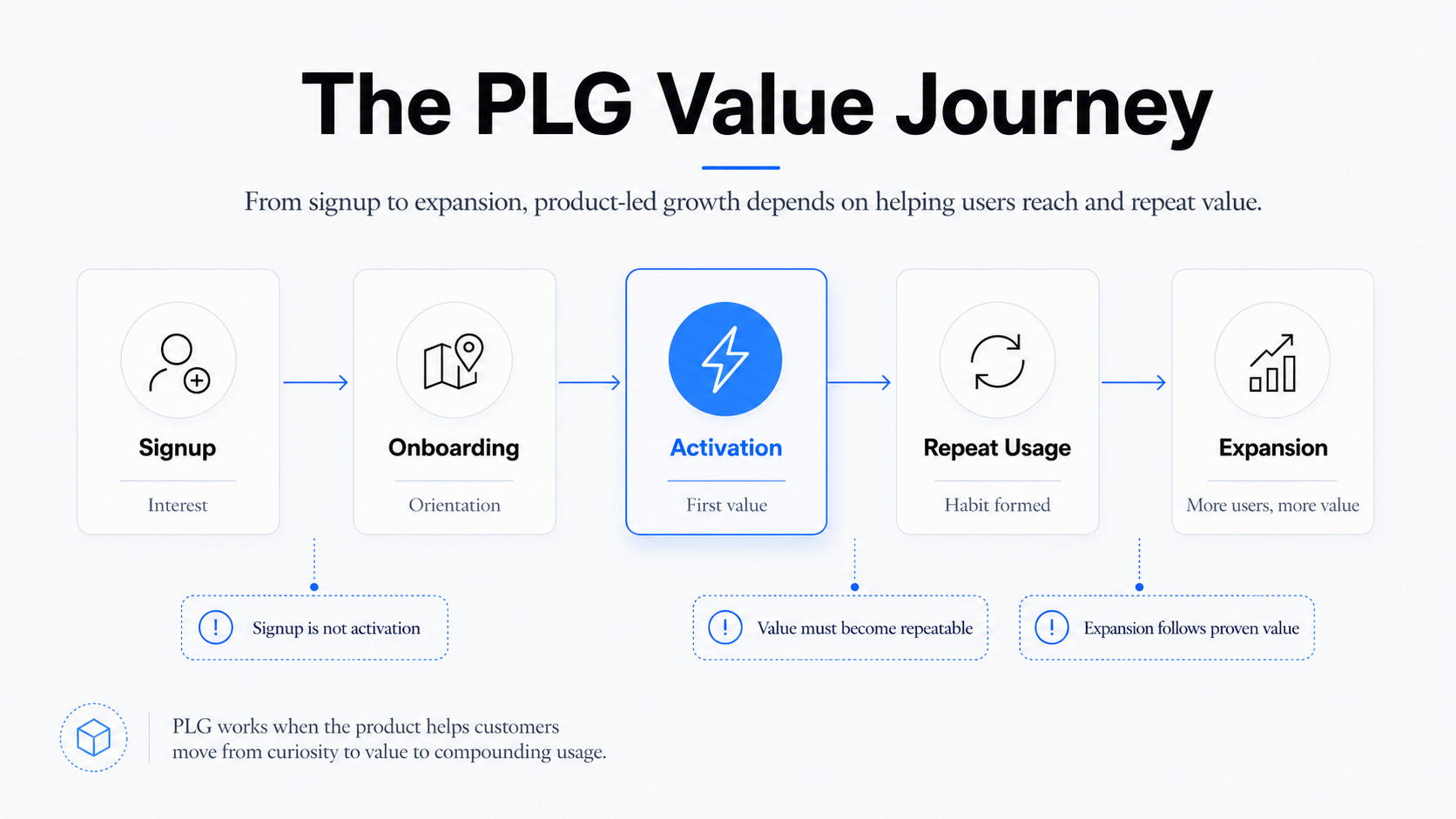
The journey usually starts with sign-up or access, but that is only an entry point. The important work begins after the customer enters the product. They need orientation, a clear path to first value, a reason to repeat the behavior, and a natural way to expand when the product becomes more useful.
This is where many teams misread their own data.
They celebrate signups as growth, but a signup is only a signal of interest. They celebrate onboarding completion, but completion is not the same as belief. They celebrate usage, but not all usage is valuable. They celebrate expansion, but expansion is fragile if the core product experience has not earned trust.
A better way to evaluate the journey is to ask what job each stage is supposed to perform.
Signup should capture intent from the right audience. Onboarding should orient the customer toward a meaningful outcome. Activation should deliver first value. Repeat usage should turn that value into a habit, workflow, or recurring need. Expansion should follow from deeper value, broader adoption, more use cases, or measurable business impact.
When those stages connect, PLG starts to compound.
The product does not merely acquire users. It teaches them. It helps them make progress. It creates evidence. It reveals intent. It gives the company better signals. It creates expansion paths that feel like a continuation of value rather than a forced upsell.
That is the difference between a product with a funnel and a product-led growth system.
The operating system behind PLG
Product-led growth is often described in terms of the user experience, but the internal operating system is just as important.
A company can have a strong product and still struggle with PLG if the functions surrounding the product are misaligned. Marketing may attract the wrong audience. Sales may engage too early or too late. Customer success may compensate for product gaps instead of helping the team learn from them. Pricing may block the value from being understood before the customer does. Product analytics may track activity without explaining outcomes.
PLG works when the company organizes around customer value.
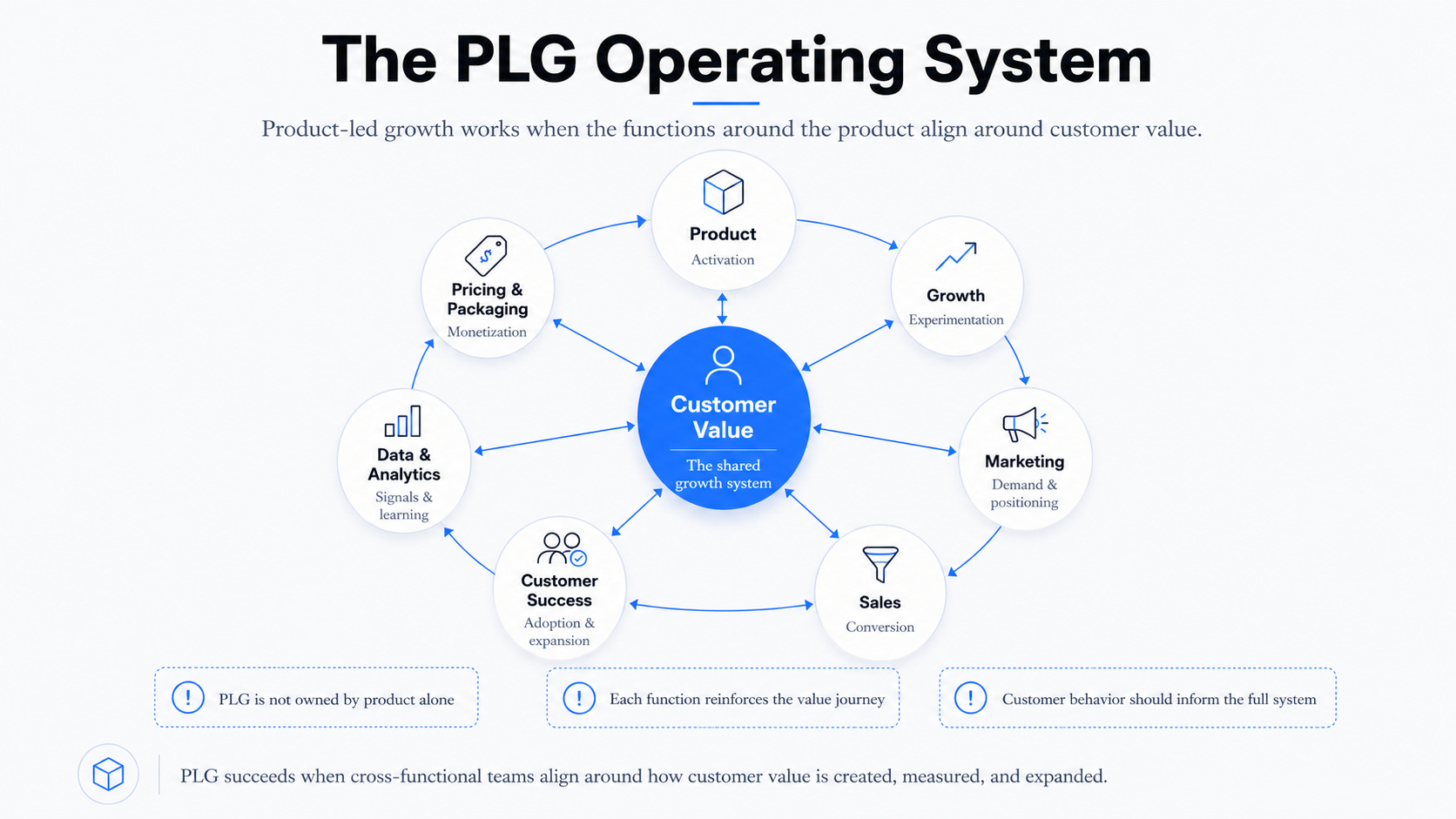
Product owns the experience that creates and delivers value. Growth helps improve the journey through experimentation and learning. Marketing clarifies the promise and attracts the right audience. Sales converts high-intent accounts and expands opportunities where human judgment matters. Customer success helps customers deepen adoption and realize outcomes. Data and analytics help the company understand behavior. Pricing and packaging determine how value is accessed and monetized.
None of these functions can be treated as separate from the product-led system.
This is why PLG should not be reduced to a product team initiative. The product may be the center of the motion, but the company has to operate around the same value journey. Otherwise, each team optimizes its own part of the system, and the customer experiences the gaps.
A common example is acquisition quality. Marketing may drive strong signup volume, but if those users do not activate, the issue may not be onboarding alone. The problem may be positioning, audience selection, promise clarity, product fit, or packaging. The product team can improve the experience, but it cannot resolve a mismatch that existed before the user ever entered the product.
Another example is expansion. Sales may want more expansion opportunities, but if the product does not reveal deeper use cases, create internal champions, or generate meaningful usage signals, the expansion motion becomes dependent on persuasion rather than evidence.
PLG creates leverage when the product and the organization reinforce each other.
A practical framework for understanding PLG
The cleanest way to understand PLG is through four questions.
Can the product create value directly?
This is the foundation. The product must allow the customer to experience value without requiring the company to explain everything manually. The more complex the product or market, the more support may be needed, but the product still needs to carry a meaningful part of the value journey.
Can the customer reach that value quickly enough?
Speed to value matters because attention is limited and trust is fragile. Customers do not need to understand the entire product immediately. They need to understand enough to make progress and believe that continued usage is worth their time.
Can value become repeatable?
PLG is not built on a single good first session. It depends on repeated behavior. The product needs to be useful in a recurring context, whether that is a personal workflow, a team collaboration pattern, a business process, a data loop, or an ongoing operational need.
Can value expand naturally?
Expansion should be tied to how the customer gains more value. That may come through more seats, more usage, more workflows, more data, more integrations, more teams, or more advanced capabilities. The key is that expansion should feel like a logical next step from proven value.
Those four questions are more useful than asking whether a company has a free trial, a freemium plan, or a product-qualified lead model. The visible tactics only matter if the underlying value system works.
Where PLG fails
PLG usually fails for one of five reasons.
The first is an unclear value. The product may be useful, but the customer cannot quickly grasp its value. This creates weak activation and high early drop-off.
The second is weak onboarding. The product explains its features rather than guiding the customer toward progress. The user learns what exists, but not why it matters or what to do next.
The third is poor retention quality. Users may try the product, but the product does not become part of a recurring workflow or habit. The first experience creates interest, but not durable adoption.
The fourth is misaligned packaging. The customer either cannot access enough value to understand the product or receives so much value for free that monetization becomes disconnected from usage.
The fifth is organizational fragmentation. Product, marketing, sales, customer success, and data operate around different definitions of success. The company talks about PLG, but the operating model still behaves like a collection of disconnected functions.
These failure modes are common because PLG exposes the truth of the product experience. If customers cannot reach value, PLG will reveal it. If users do not retain, PLG will reveal it. If pricing does not match the value journey, PLG will reveal it. If the organization is not aligned, PLG will reveal that too.
That is not a weakness of PLG. It is one of its strengths.
A product-led motion gives leaders a clearer view of where the system is working and where it is breaking.
The real test of PLG
The simplest test of PLG is whether the product can help customers make meaningful progress with less force from the organization.
That does mean no sales, no customer success, no marketing, and no implementation support. It means those functions are built on evidence generated by the product, not compensating for its absence.
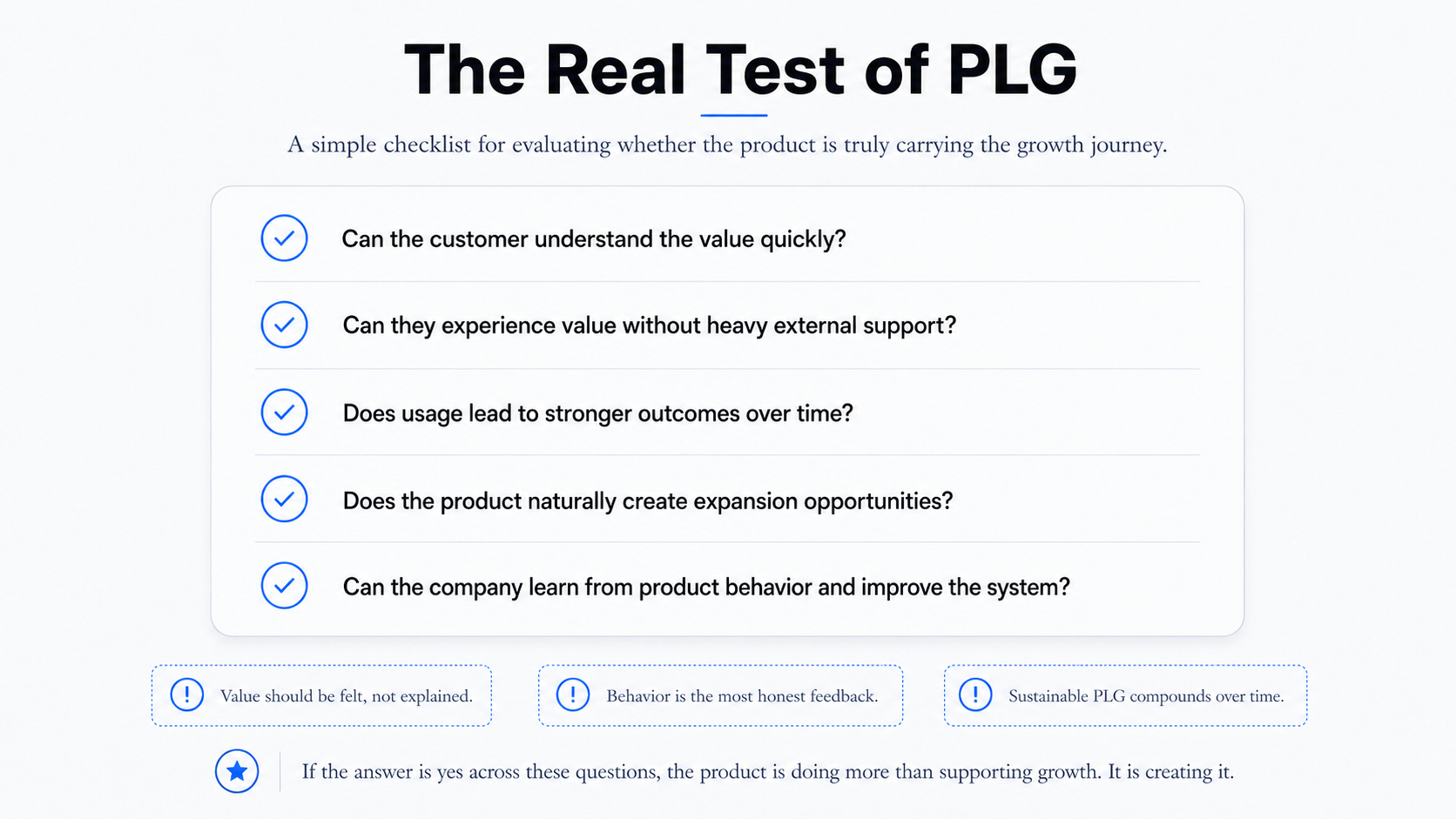
A product-led company should be able to answer five questions with confidence.
Can the customer quickly understand the value?
Can they experience value without heavy external support?
Does usage lead to stronger outcomes over time?
Does the product naturally create opportunities for expansion?
Can the company learn from product behavior and improve the system?
If the answer is yes across those questions, the product is doing more than supporting growth. It is creating it.
That is the real promise of product-led growth.
Not a cheaper acquisition. Not a cleaner funnel. Not a free plan with better analytics. Those may be outcomes or supporting mechanisms, but they are not the core idea.
The core idea is that customer value and business growth should be directly connected through the product experience.
That is what product-led growth is.
And it is the standard that more product organizations should aim to meet.