

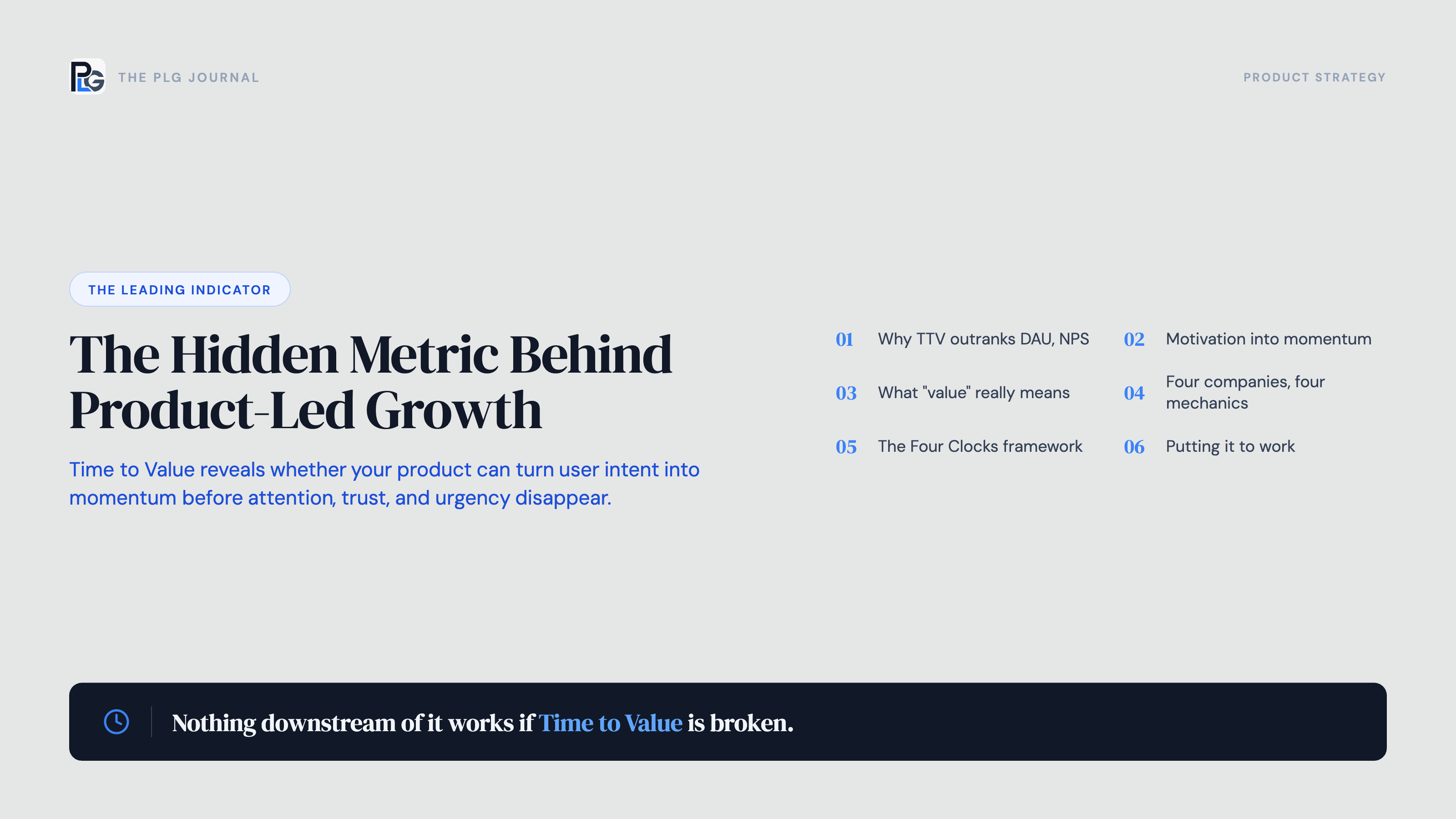
Most product teams don’t realize they have a Time-to-Value problem. They discover a DAU problem, a retention problem, a “sales says leads are weak” problem, a “CS says customers are confused” problem. Different symptoms, same disease.
Nobody traces it far enough back to see the real question: how long does it take a new user to see proof that your product can deliver what they came for?
That gap, between intent and experienced value, is Time to Value. And most organizations are diagnosing everything downstream of it while ignoring it entirely.
The instinct when activation is weak is to fix activation. Add onboarding flows. Add lifecycle emails. Run an NPS program. Add more qualified leads. None of these moves is wrong. They’re just late. Their treatment is for a symptom, not the disease.
Why TTV outranks the metrics you’re already tracking
DAU tells you someone showed up. Amplitude counts anyone who opened or viewed the product on a given day as a count, which is a low bar. Retention indicates whether they came back. NPS tells you what they say about the experience after the experience has already happened.
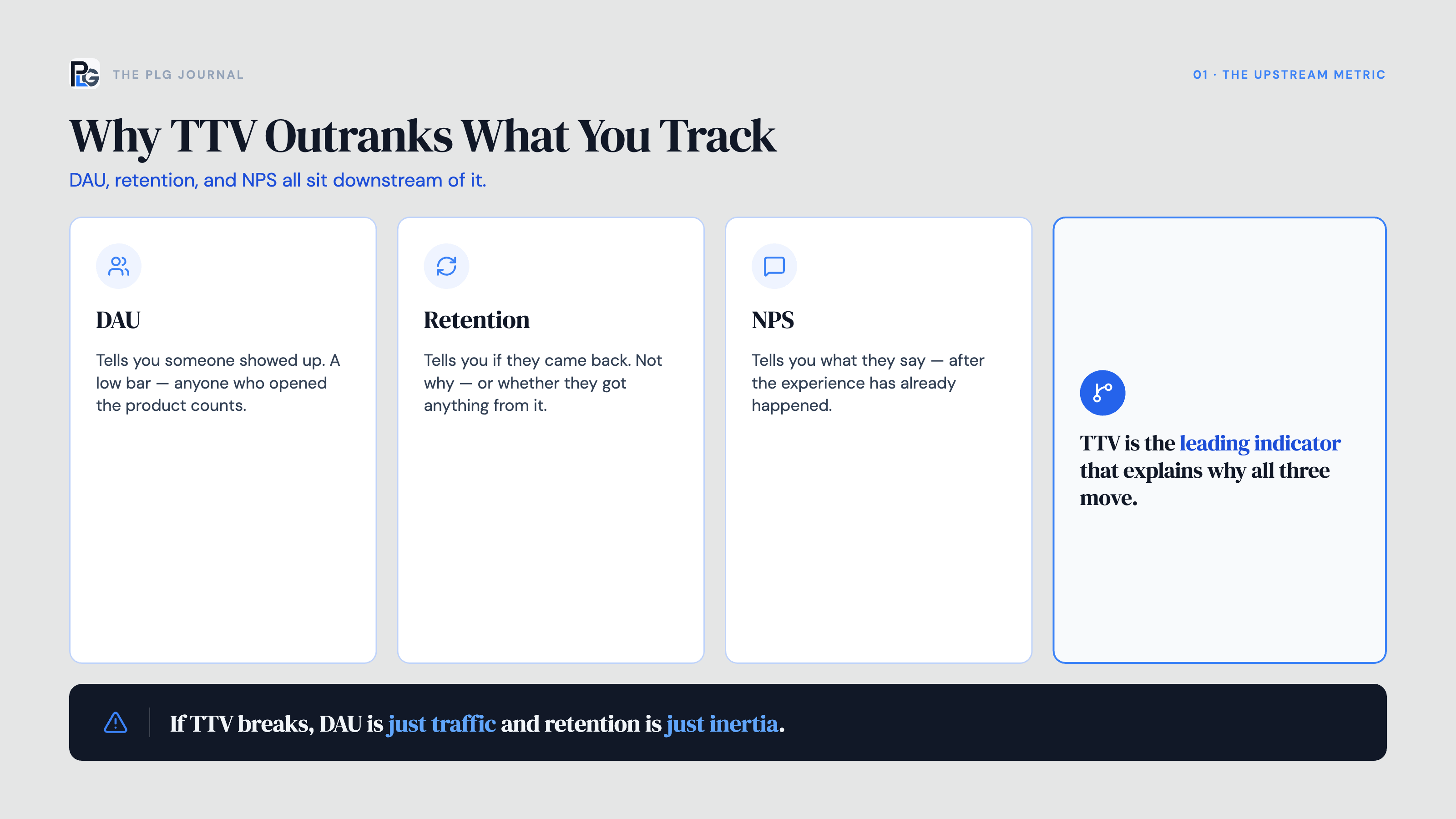
TTV sits upstream of all three. It’s the leading indicator that explains why the others move. If TTV is broken, DAU is just traffic; retention is just inertia; and NPS measures goodwill toward a product people haven’t actually gotten value from yet.
The thesis
Time to Value measures your product’s ability to convert motivation into momentum. Every product-led motion depends on this conversion; if it fails, nothing else in the funnel works.
A user shows up with a job to do. The product has a short window to prove that the effort will be rewarded. The faster and clearer the proof, the more likely they are to stay, invite others, build habits, expand usage, and eventually pay.
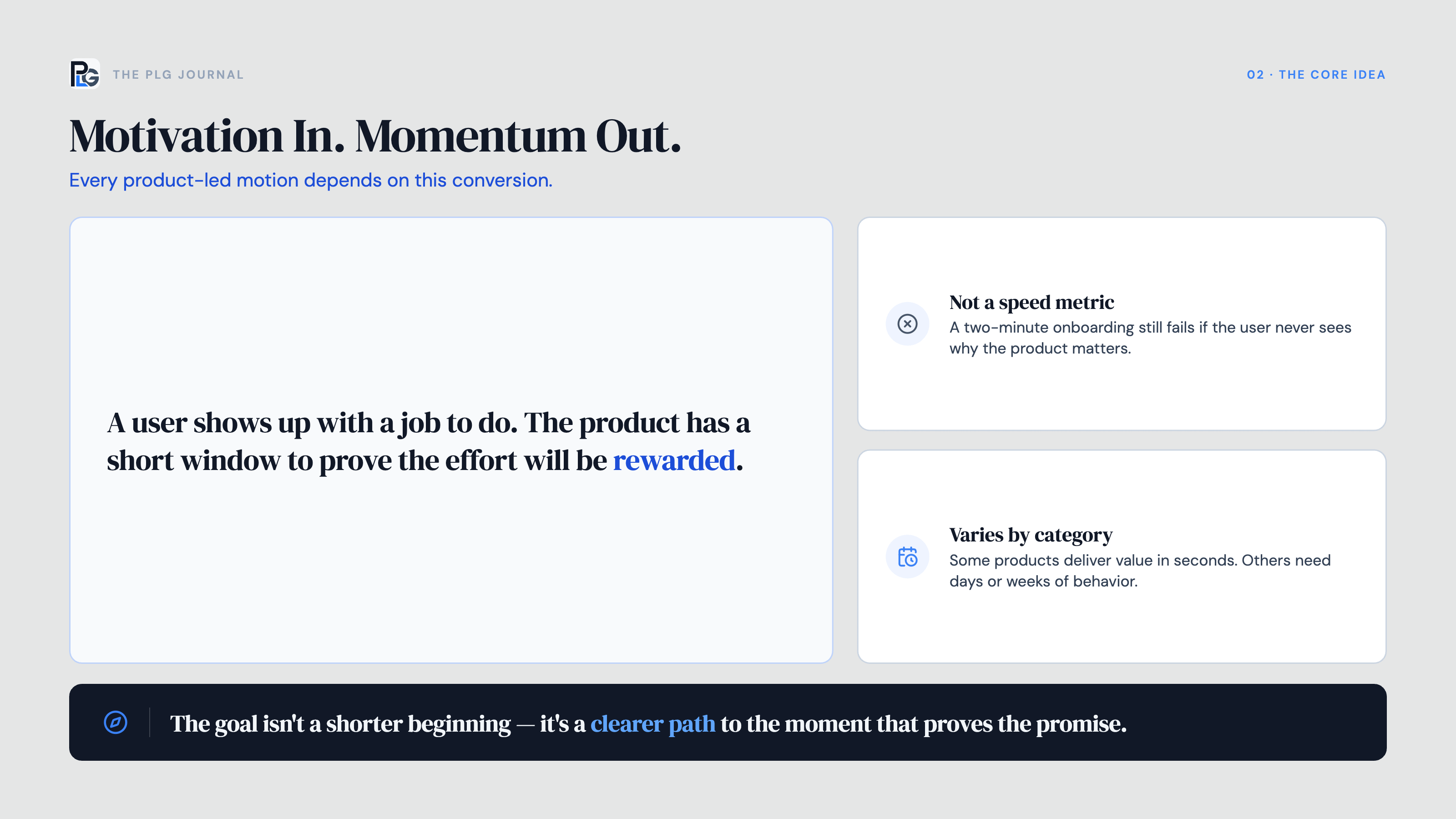
This does not mean every product needs instant gratification. Some products reach value in seconds; others need days or weeks of accumulated behavior before the promise becomes real. The value moment depends on the category, the job, and whether the value is individual, collaborative, or organizational. What’s constant is that a real moment exists, and most teams have never precisely located it.
This is also where teams most often get TTV wrong: they treat it as a speed metric. Fewer clicks, shorter signup, faster setup. Speed helps, but it isn’t the point. A user can finish onboarding in two minutes flat and still have no idea why the product matters. The goal isn’t a shorter beginning. It’s a clearer, faster, more reliable path to the moment that proves the product’s promise.
What most teams get wrong about “value”
Most teams define value from the product’s perspective. A user is “activated” once they’ve done what the company wants: created an account, invited a teammate, connected an integration, completed onboarding, and watched a demo. Some of these actions correlate with value. None of them are value.
The user doesn’t care that they “completed onboarding.” They care that the product helped them schedule the meeting, ship the design, close the loop, or make the decision. This is where PLG systems quietly break: teams instrument what’s easy to measure, then mistake activity for progress. A dashboard view isn’t valuable if the user doesn’t know what to do with it. A connected integration isn’t valuable if the workflow isn’t actually better.
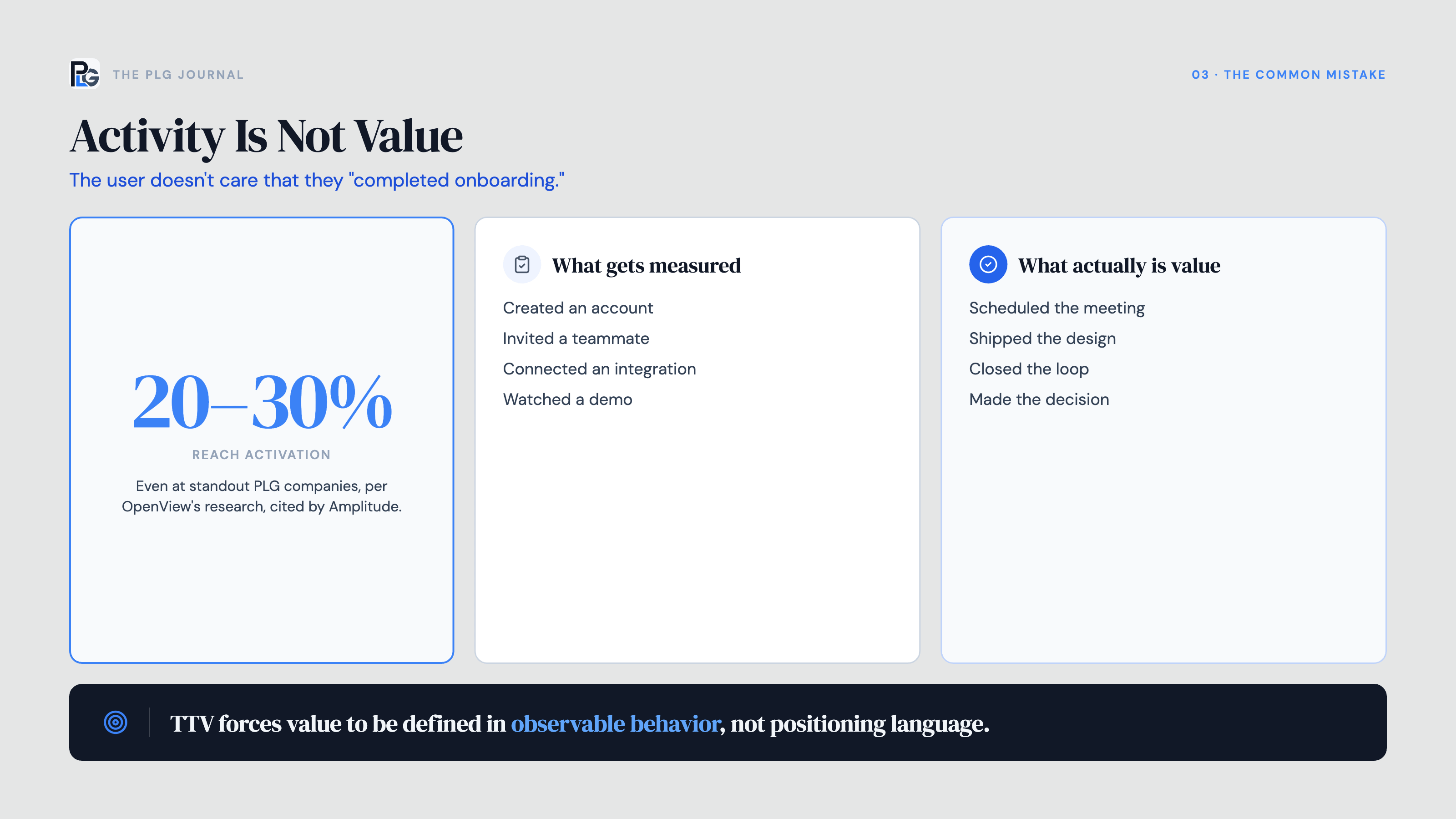
OpenView’s benchmark research on PLG companies, cited by Amplitude, found that even at standout PLG companies, only 20 to 30 percent of new users ever reach activation. That’s not an onboarding problem. That’s because most users never reach the moment that proves the product was worth trying in the first place.
This is why TTV is such a useful executive metric, arguably the most useful one. It forces a company to answer, in terms of observable user behavior rather than positioning language, what “value” actually means.
Four companies, four different value mechanics
The best PLG companies don’t share a playbook. They share a discipline: know precisely what value looks like for your product, then build the shortest reliable path to it. The four below are useful because their value mechanics look nothing alike.
Superhuman: value is a habit that has already formed.
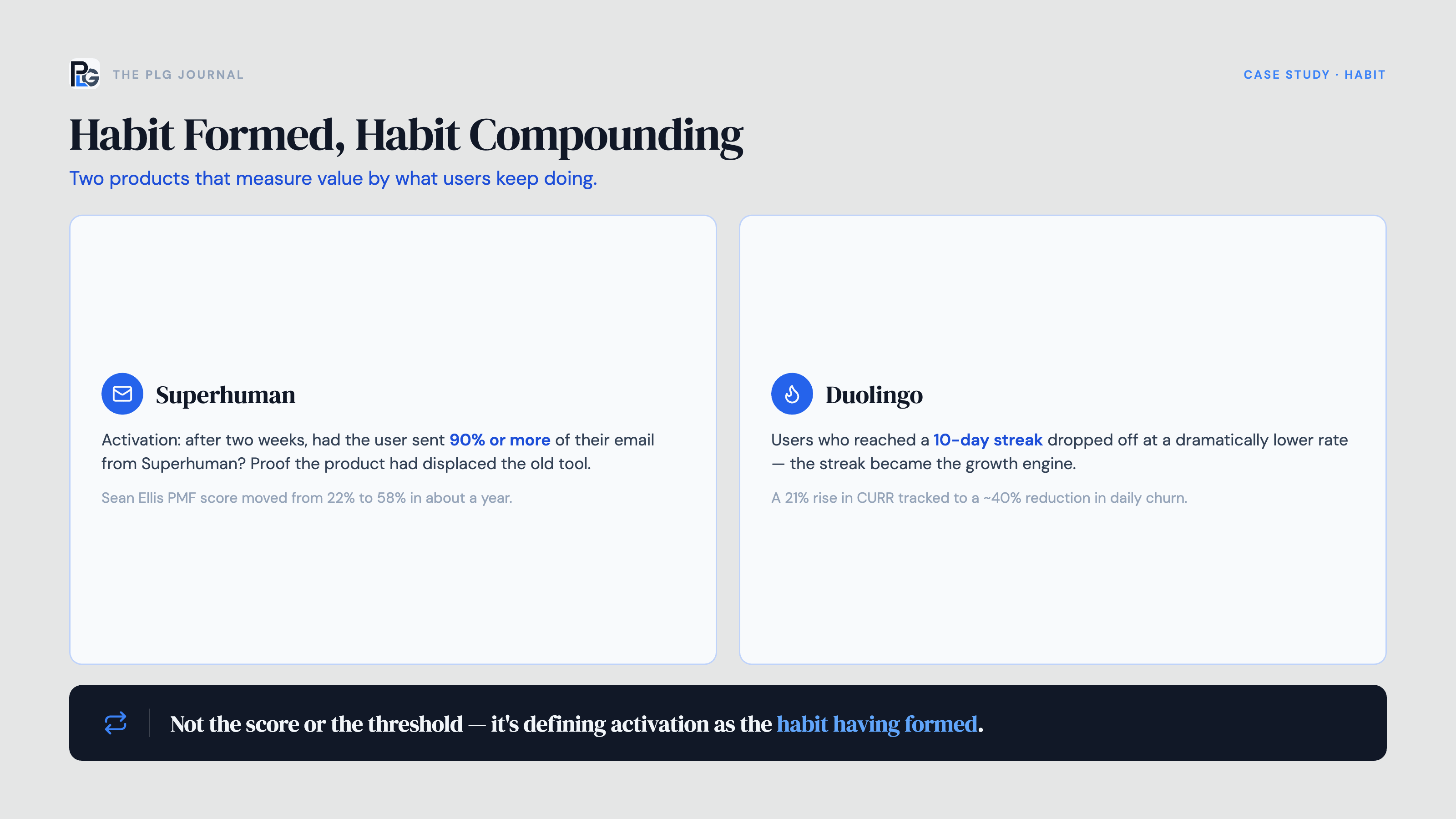
When Rahul Vohra was searching for product-market fit for Superhuman, he adopted Sean Ellis’s survey question (”How would you feel if you could no longer use the product?”) and treated the percentage of users answering “very disappointed” as a quantitative PMF metric, with 40% as the benchmark for strong growth.
Superhuman began at 22% and increased to 58% over about a year by segmenting to identify their highest-value customers. They focused their roadmap on enhancing features that users loved and eliminating objections for fence-sitters. The key activation metric used to distinguish genuine value from superficial engagement was whether, after two weeks, the user had sent 90% or more of their emails through Superhuman.
That’s not a setup event or a first action. That’s proof the product had displaced the previous tool. What doesn’t transfer is the survey score or the 90% threshold on its own; the transferable move is to define activation as the habit having formed, not as the first time the value was tasted.
Duolingo: value compounds over time, and the streak is the mechanism.
By mid-2018, Duolingo’s DAU was growing single-digits year-over-year, and CPO Jorge Mazal’s team went hunting for a retention lever. Analysis showed that users who reached a 10-day streak dropped off at a dramatically lower rate, turning the streak from a nice-to-have feature into the growth engine.
The team invested heavily in streak-savers, streak-freezes, calendar views, and reminders, and eventually grew DAU 4.5x over four years. Erin Gustafson has written about the accompanying Growth Model, a Markov-style framework that breaks DAU into user states such as Current, At-Risk, and Resurrected, with Current User Retention Rate (CURR) emerging as the key transition metric to track.
A 21% boost in CURR led to about a 40% drop in daily churn among top users. However, simply adding a streak feature doesn’t always transfer well. Streaks work for Duolingo because language learning is a virtue-based, habit-forming process where users aim to stay motivated during both low- and high-effort moments.
The key transferable insight is that, in some categories, TTV (time to value) is measured in days of continued use rather than minutes to see initial results. Additionally, Core Value emerges only after enough repetitions to establish a habit.
Zapier: value is the product doing work while you’re not watching.
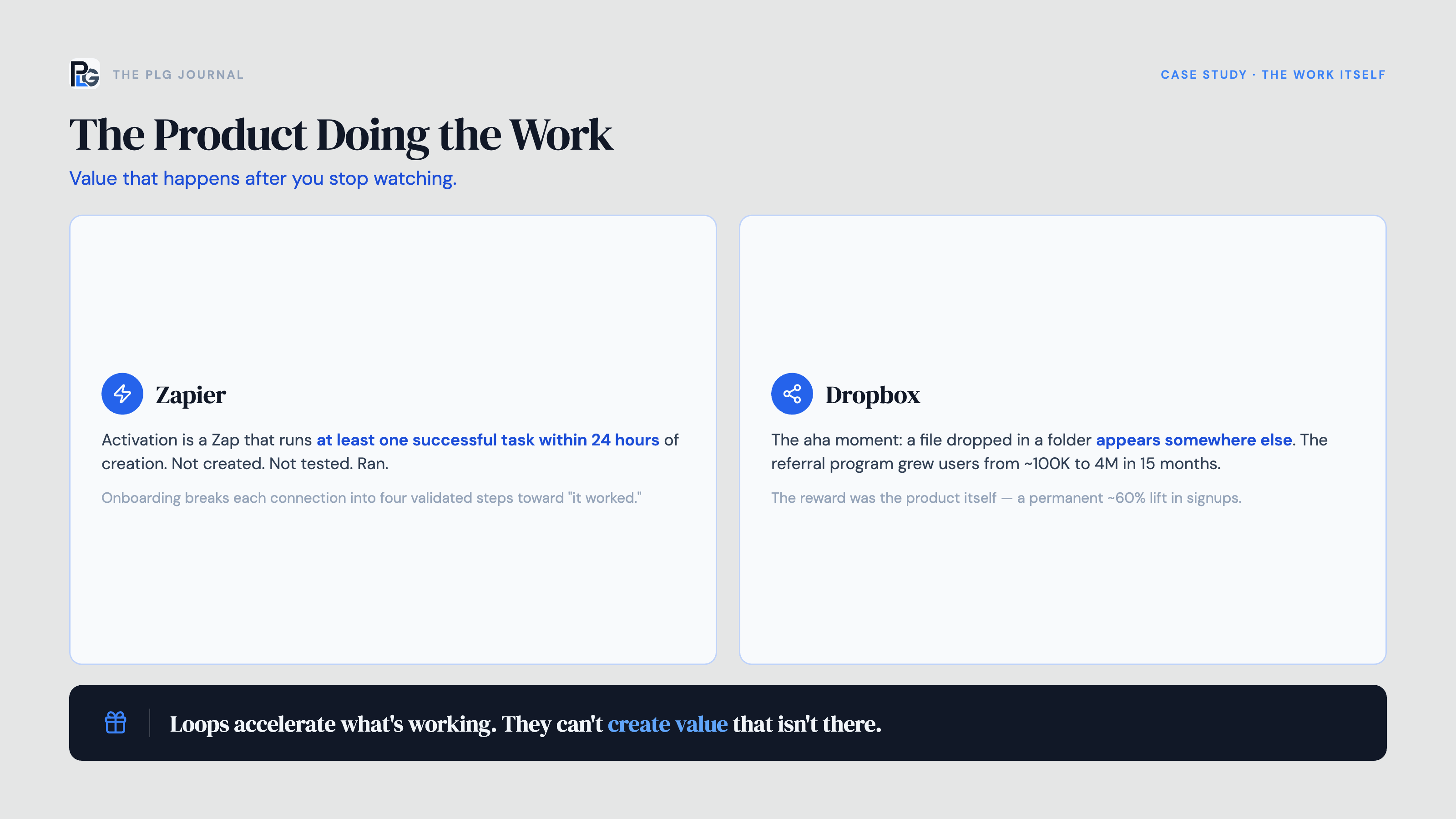
Zapier’s activation event, per their own platform documentation, is a Zap that runs at least one successful task within 24 hours of creation. Not a Zap created. Not a Zap tested. A Zap that actually executed and did the thing.
That definition is strong because it captures the essence of automation: the value isn’t in configuring the workflow; it’s in the workflow running afterward without you. Zapier’s onboarding is built around this: their editor breaks each app connection into four validated steps (app and event, account, trigger, test), each with a single primary CTA, so the user reaches “it worked” as quickly as possible.
Templates then power the growth loop by ranking in search for narrow use cases (”send Slack message when Typeform is submitted”), pulling in users at the exact moment they’re trying to solve that problem and dropping them into a pre-built starting point. What doesn’t transfer is programmatic SEO on its own; that only works for horizontal use cases.
The transferable insight is that for automation, AI, and agent products, “the user did X” isn’t activation. The activation event is “the product delivered a result back to the user.”
Dropbox: value is invisible sync, and the reward for referring is the product itself.
Dropbox’s aha moment is deceptively boring: a file gets dropped into a folder and appears somewhere else. That single event is commonly cited as their activation moment because it’s the smallest observable proof that the promise (“your files, everywhere”) is real.
What makes Dropbox worth studying is that what happened after that value moment was reliable. Sean Ellis discovered that roughly a third of Dropbox signups were already coming from word of mouth before the referral program even existed.
Drew Houston’s team then built the now-famous double-sided referral program (500MB of storage for both the referrer and the invitee, capped at 16GB), which drove growth from around 100,000 users to 4 million in 15 months and delivered a permanent ~60% lift in signups.
The mechanic worked because the reward was the product: every successful referral made Dropbox more valuable to the referring user, reinforcing the underlying habit. What doesn’t transfer is the referral program in isolation. Most companies bolt referrals onto weak products and expect them to generate word-of-mouth.
Dropbox captured existing word-of-mouth because the product’s TTV was fast and the value moment was reliable. Loops accelerate what’s working; they can’t create value that isn’t there.
Four products, four mechanics. Same discipline: find the moment the promise becomes real, then build toward it on purpose.
Where Time to Value breaks
Teams measure time to setup instead of time to outcome. Sign-up takes 90 seconds, and everyone celebrates, while users still need 3 days, 2 support articles, and a CS call to get an actual result.
Activation is defined as convenient rather than predictive. If your activation event doesn’t correlate with retention, conversion, or expansion, it isn’t activation. It’s just an action someone was willing to track. Superhuman’s “90 percent of email sent from Superhuman after two weeks” is a good example of the opposite: it’s harder to move, but when it moves, it actually means something.
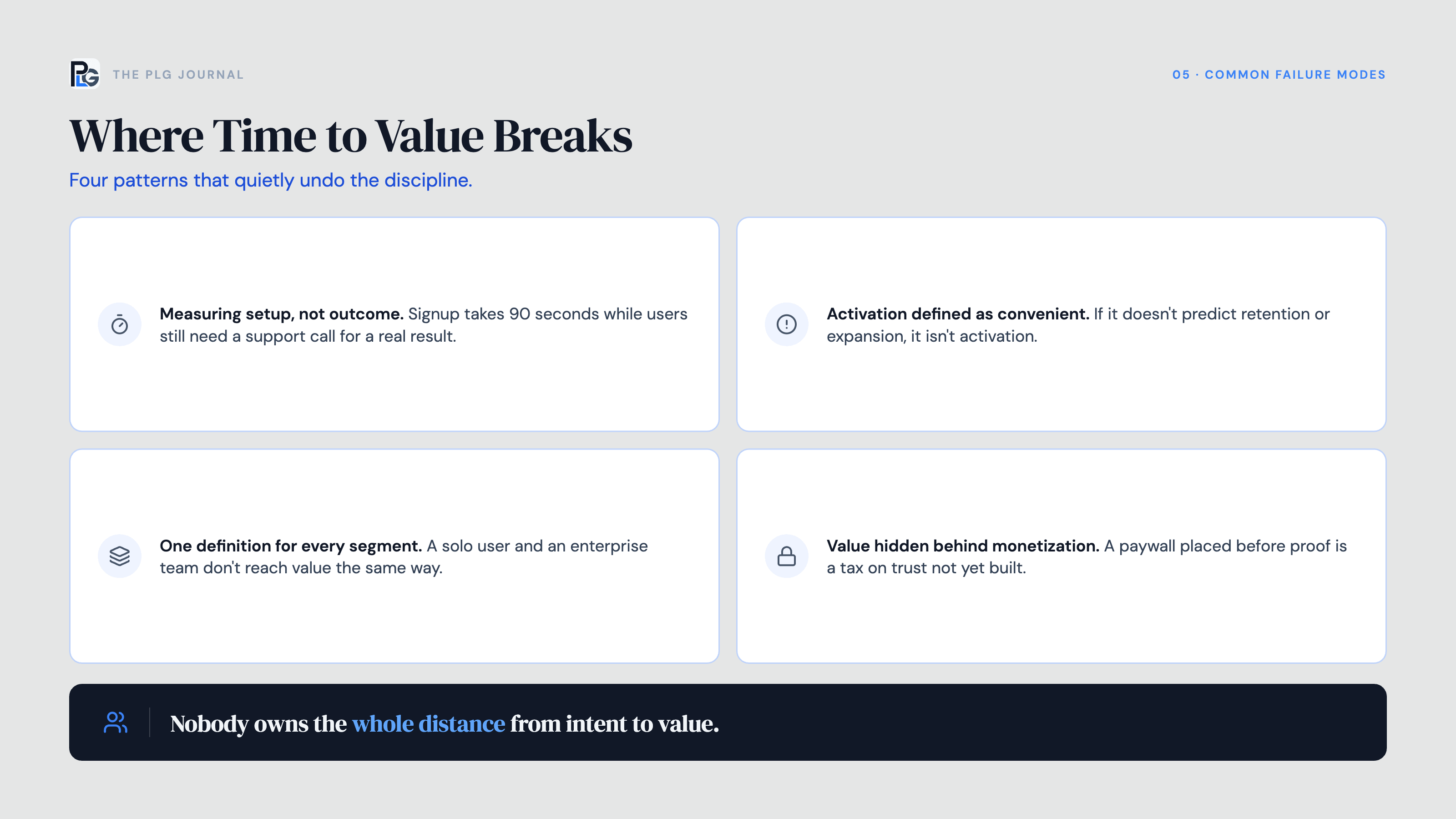
One TTV definition gets applied to every segment. A solo user might reach value by answering one urgent question. An enterprise team might not realize value until data is trusted, permissions are configured, and decisions are actually made using the tool. Compressing TTV for one segment can create confusion or false confidence for another.
Value gets hidden behind premature monetization. Paywalls work when they come after proof has accumulated. A paywall placed before proof isn’t monetization; it’s a tax on trust the user hasn’t built yet.
Nobody owns the whole distance. Product owns onboarding. Marketing owns acquisition. Sales owns conversion. CS owns adoption. Each team optimizes its slice. No one owns intent-to-value end-to-end. That’s how companies end up with a polished funnel wrapped around a product that hasn’t actually proven itself yet.
The Four Clocks of Time to Value
Stop treating TTV as a single number. Most products have four separate clocks running.
Time to First Value. The first moment of credible proof: Zapier’s first successful Zap run, Dropbox’s first synced file, an AI product’s first output that’s actually good enough to use. This clock earns the next session.
Time to Core Value. The point where behavior starts predicting retention or conversion. Duolingo’s 10-day streak is the classic case; Superhuman’s 90% of emails through the product after two weeks is another. The user has moved past curiosity into meaningful use. This clock is what separates real activation from a vanity event.
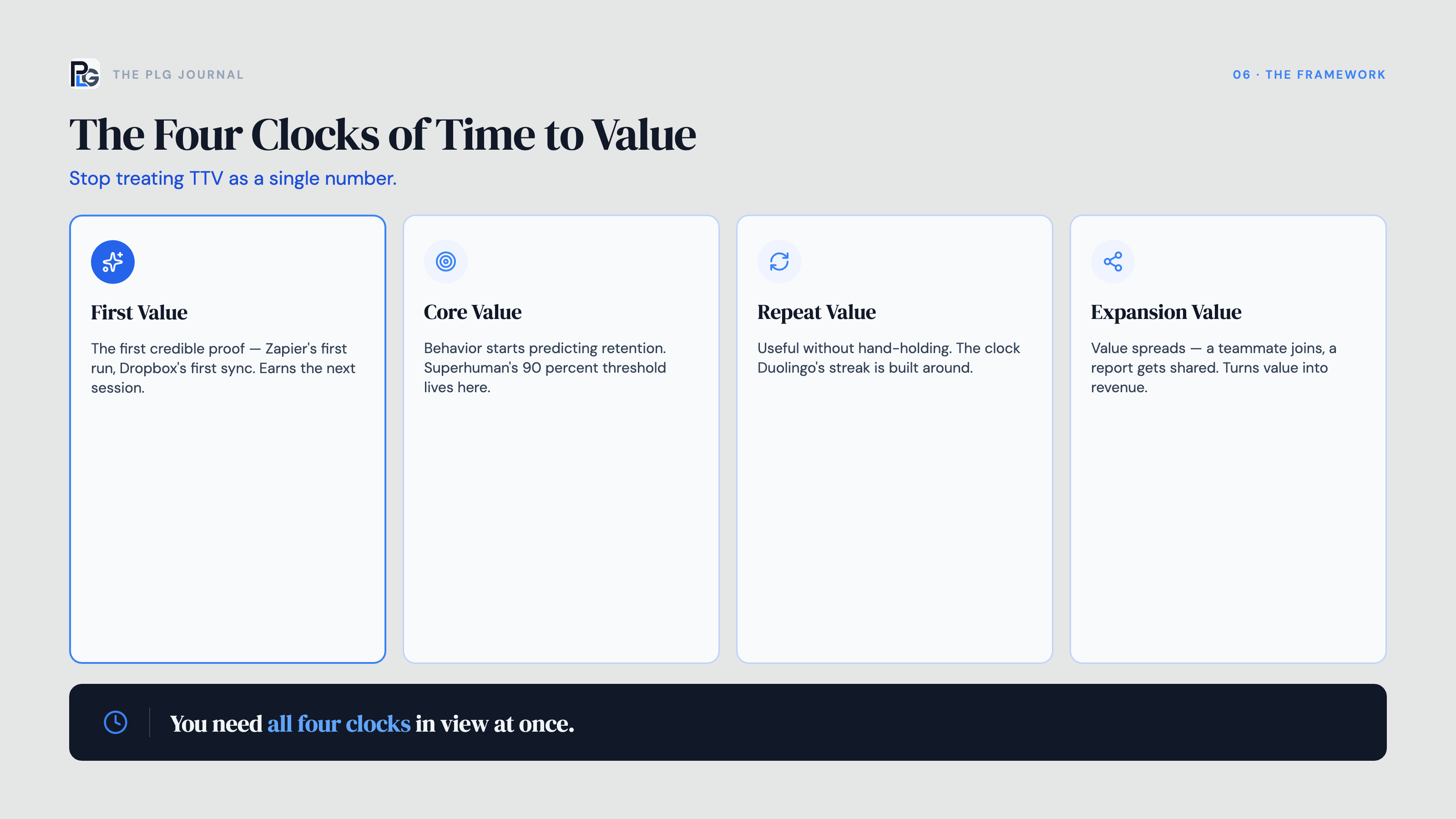
Time to Repeat Value. Onboarding can push a user to value once. Repeat value tells you whether the product is useful without hand-holding, which is where habit and real retention begin. This is the clock Duolingo is essentially built around.
Time to Shared or Expansion Value. In most B2B products, value doesn’t become strategically important until it spreads: a teammate joins, a report gets shared, an admin standardizes usage. In consumer products, it’s the referral loop, the Dropbox mechanic. This is the clock that turns individual value into revenue.
Teams that only optimize the first clock end up with strong trial conversion and flat expansion. Teams that only watch the fourth clock end up with beautiful case studies and a leaky top of the funnel. You need all four in view at once.
Putting it to work
Start narrow. Write one sentence per major segment: “This user comes to us to do X, and value is proven when Y happens.” If the sentence could describe five competitors equally well, it isn’t specific enough yet.
Then find the smallest observable behavior that proves first value, chosen because it predicts retention or expansion, not because it’s easy to log. Map the current path from intent to that moment, step by step, and mark each step as value-creating, value-enabling, or company-required. The company-required steps are almost always where the friction is hiding.
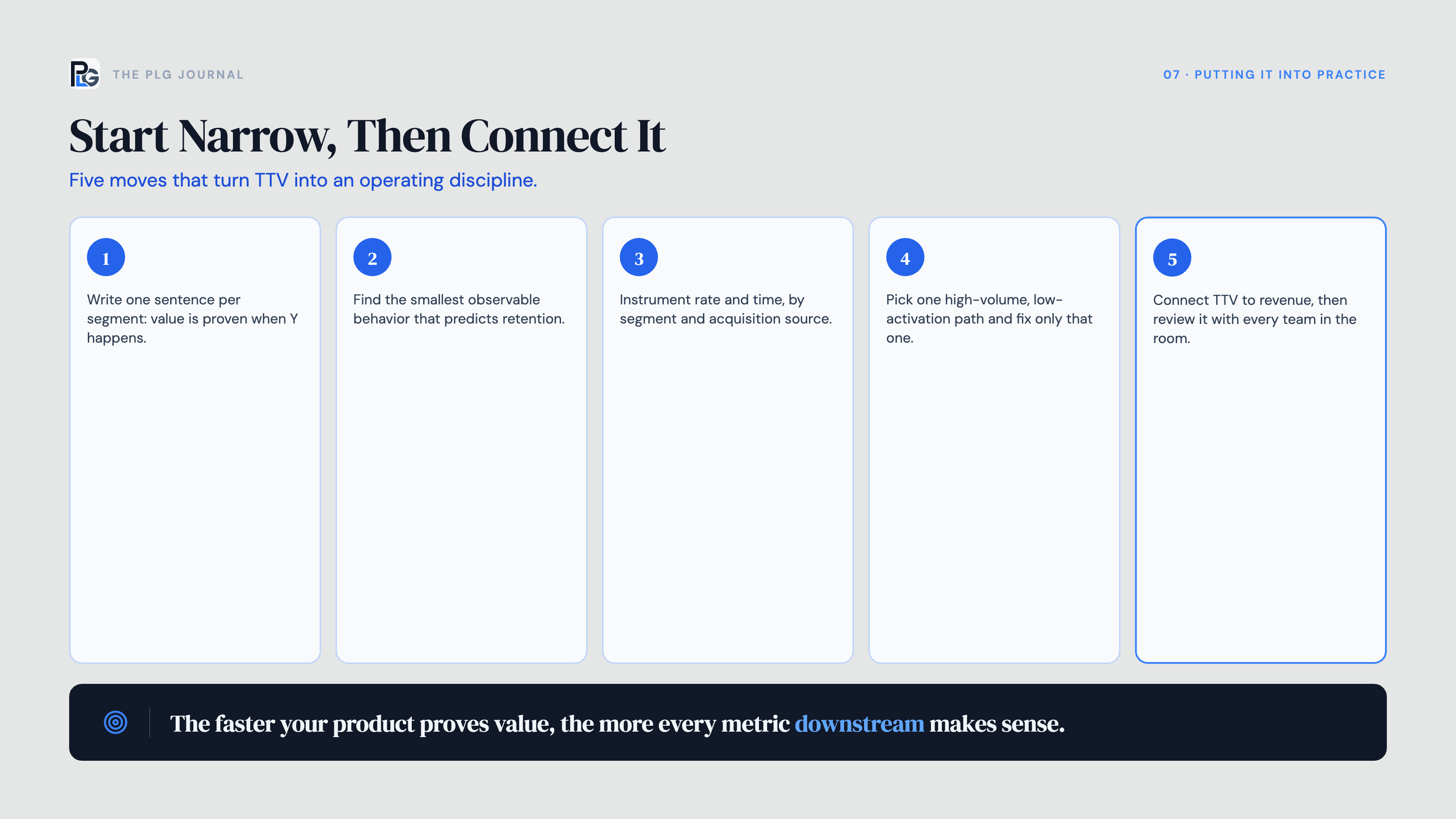
Instrument rate and time together, by segment and by acquisition source: percentage reaching first value, median time to get there, percentage reaching core value, time from first to repeat value. Then go qualitative. Watch sessions of users who failed to activate. Read support tickets. Ask sales what prospects expected, and ask CS what customers misunderstood. You’re hunting for the gap between the promise a user believed and the proof the product actually delivered.
Pick one high-volume, low-activation path and fix only that one. Replace generic education with guided progress. Replace blank states with useful starting points. Replace feature tours with task completion.
Once that’s moving, connect TTV to revenue. Do users who reach first value faster convert at higher rates? Do users who reach the core value expand? Are paywalls landing before or after proof? Then make it permanent: review TTV by segment, channel, and account, not just by individual user, with product, growth, marketing, sales, CS, data, and engineering in the same room.
Closing
DAU can rise while value stays shallow. Retention can tell you someone left, months after it mattered. NPS can tell you that customers are happy without ever showing you how a new user becomes one of them.
Time to Value sits closer to the source. It asks whether your product can turn motivation into proof before attention and trust run out. It forces value to be defined in the customer’s terms instead of the pitch deck’s. And it connects acquisition quality, onboarding, activation, retention, monetization, and expansion into a single operating question, rather than five separate ones owned by five separate teams.
Superhuman had to prove speed hard enough that users moved their email in. Duolingo had to earn one more day, over and over, until the streak became an identity. Zapier had to make the automation run, not just exist. Dropbox had to make a file appear somewhere else, reliably enough that people told their friends.
Different products, different mechanics, different clocks. Same principle: the faster your product proves value, the more every metric downstream of it starts to make sense.