

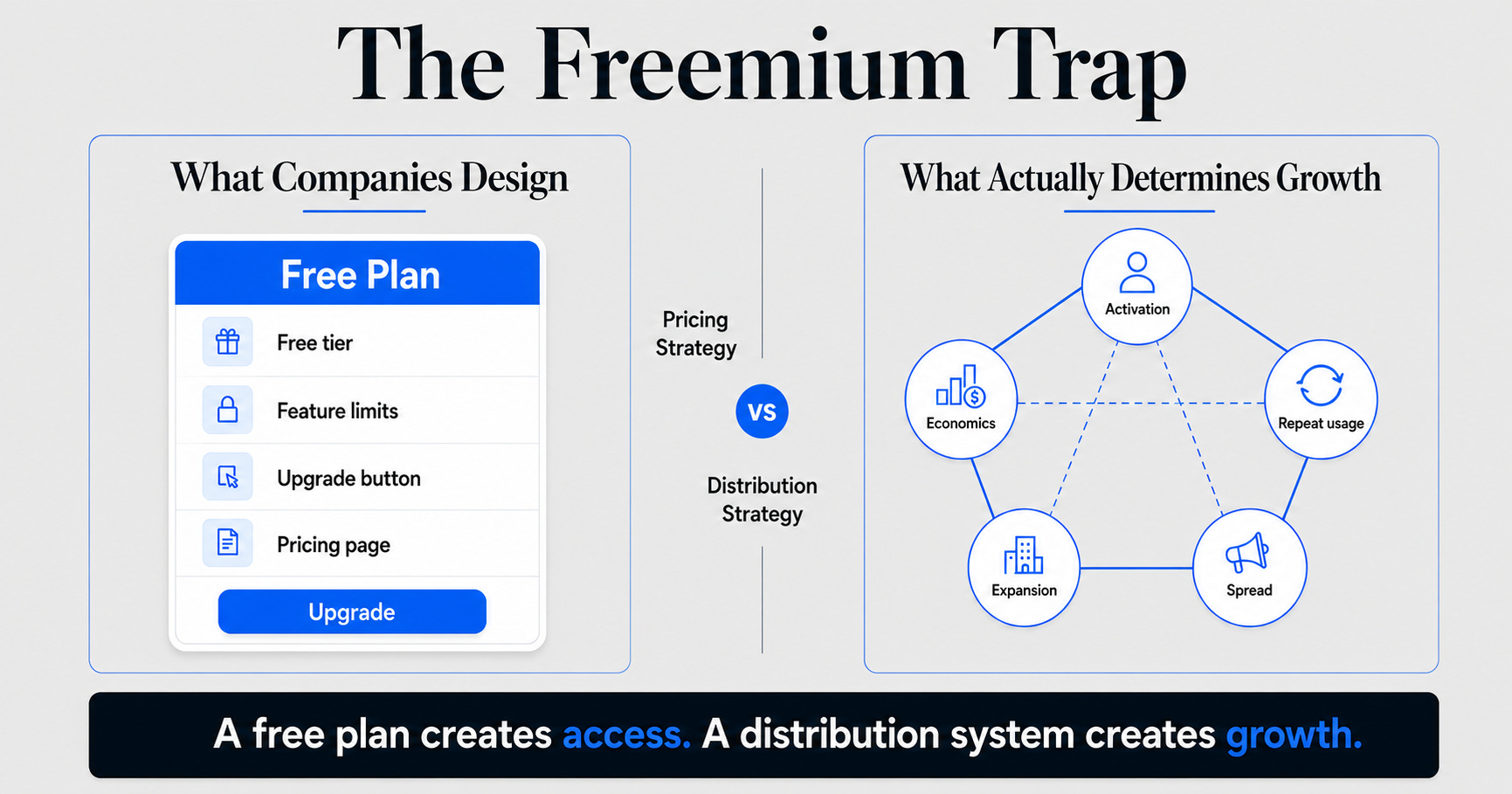
Freemium is one of the most copied growth models in software and one of the easiest to misunderstand.
On the surface, it looks like a pricing decision. A company adds a free tier, limits a few features, creates a paid upgrade path, and waits for some percentage of free users to convert. The logic feels clean: more people can try the product, more users enter the funnel, and paid conversion happens later.
That is how many companies adopt the freemium model. It is also why many freemium motions underperform.
The strongest freemium companies were not simply giving away a cheaper version of the product. They were using the free product to create distribution. Free usage helped the product move through teams, workflows, shared files, recurring habits, referrals, templates, and customer-facing outputs.
That is the distinction most teams miss.
Freemium is not valuable because it removes the price. It is valuable when removing the price allows the product to travel.
Slack did not become important because teams could send messages for free. It became important because a team could start using Slack without procurement, build communication habits, create a searchable work history, and expand from one team into more of the organization. Figma did not grow because design files were free. It grew because design work became collaborative, browser-based, and easy to share with stakeholders who were not designers. Canva did not scale because it gave away design tools. It scaled because free users could create real outputs, share them, reuse them, and eventually needed controls for brand, content, AI, and team.
In every instance, the free product served as more than just a pricing level; it functioned as a distribution platform.
That is the real lesson behind the freemium model. The pricing page is where the strategy becomes visible, but the strategy itself lives much deeper in the product. It lives in activation, repeat usage, collaboration, sharing, workflow expansion, and the moment when a user’s success creates a natural reason to pay.
Most companies focus on copying the visible artifact, while the top companies create the underlying system instead.
Why Freemium Is So Easy To Get Wrong
Freemium is attractive because it seems to solve a real problem: getting more people into the product.
Every product team knows the pain of friction. Prospects do not want to talk to sales. Users do not want to wait for a demo. Buyers do not always know whether the product is worth paying for. A free plan appears to remove all of that.
And sometimes it does. But lower friction at the top of the funnel does not automatically make a business stronger. It can just create more unqualified usage.
This is where the trap begins. Teams see more signups and assume they are seeing more demand. They see more active users and assume greater adoption. They see more product data and assume they are learning faster.
But freemium can make weak signals look strong.
A free signup does not prove urgency. A first session does not prove value. A free workspace does not prove team adoption. A created project does not prove a habit. A large base of free users does not prove there is a scalable growth engine underneath the product.
I have seen this mistake show up in product organizations in a very predictable way. The company launches a free plan, the top of the funnel improves, and the team feels momentum. But after a few months, the harder questions start to surface.
The free users are not converting. Support volume is rising. Product feedback is getting noisier. The most active free users are not the same users the company wants to monetize. Sales does not know which accounts are worth pursuing. The product cannot tell whether the free tier is creating learning or distraction. Finance starts asking whether the free plan is worth the operating cost.
At that point, the company realizes it did not launch a freemium strategy. It launched free access.
Those are not the same.
Free access is a pricing choice. Freemium, when it works, is a distribution model. It is a way to let the product create its own reach, trust, usage, and expansion before a traditional commercial motion has to do all the work.
The question is not whether users can start for free. It is whether free usage creates movement.
The Companies That Made Freemium Famous Did Not Use It The Same Way
One reason freemium gets misunderstood is that people group very different companies under the same label.
Slack, Dropbox, Figma, Canva, Zoom, Notion, and HubSpot are all often discussed as freemium or product-led companies. But their free products did not create growth in the same way.
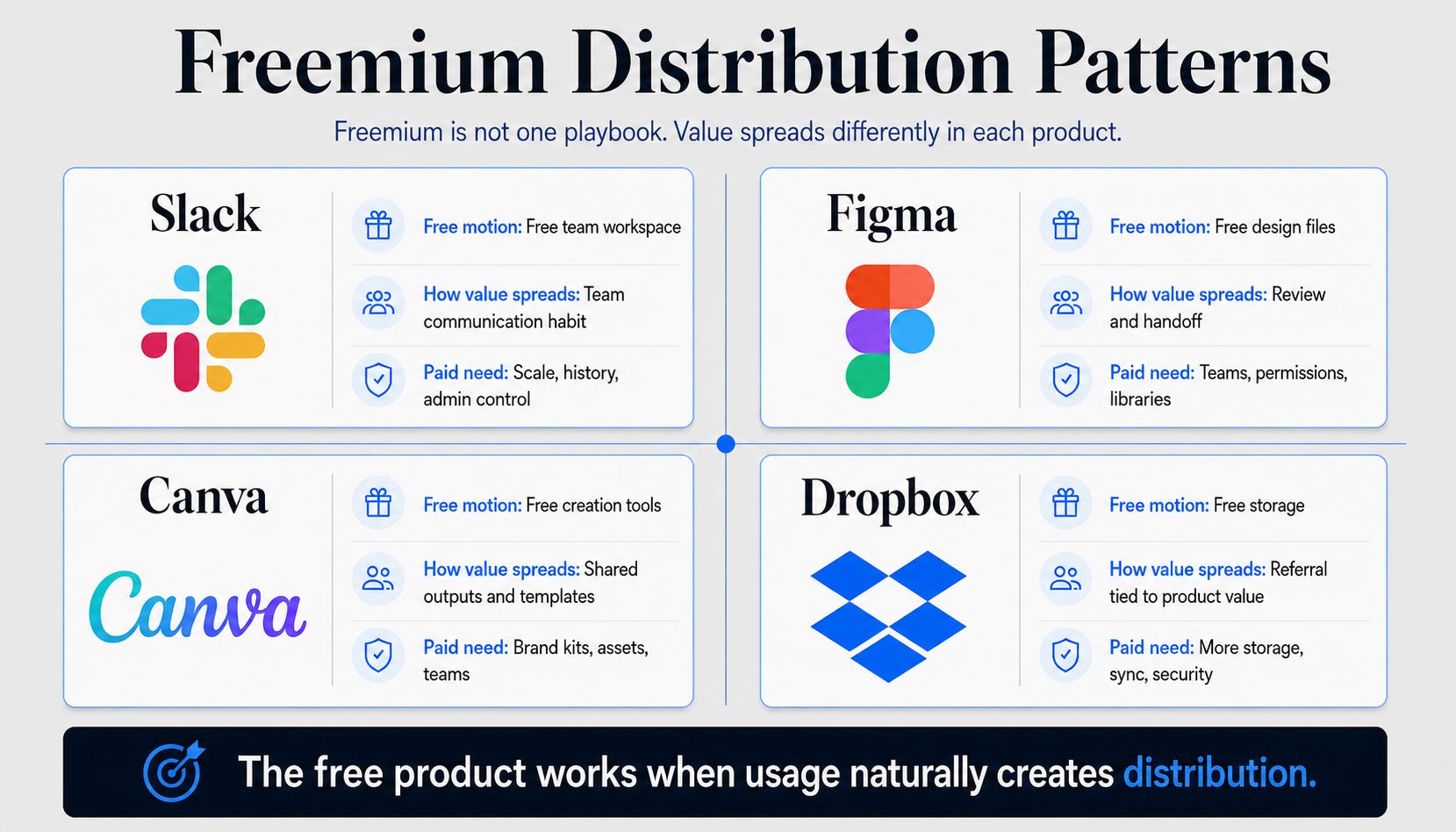
That matters because freemium is not a universal mechanism. It has to match the product's shape.
Slack’s free product worked because communication is inherently team-based. A single user cannot get the full value of Slack on their own. The product becomes more useful as more people join, as conversations move into channels, as knowledge accumulates, and as the team starts to treat Slack as a place where work happens.
Slack’s free plan gives users access to the core collaboration experience, while limits around message history, files, apps, huddles, and administration become more meaningful as the product becomes more central to the team’s workflow. Today, Slack’s free plan limits message and file visibility to the most recent 90 days, while paid plans expand history and other capabilities.
That is not a random paywall. It is a boundary that becomes more important after the team has built value inside the product.
Figma’s free experience worked through a different pattern. Figma made design multiplayer and browser-based. A designer could create a file and invite a product manager, developer, founder, client, or executive to collaborate on the work without requiring them to install a heavy desktop application.
The product’s distribution came from the workflow itself. Design work needed feedback, review, handoff, and collaboration. Figma made those moments easier, and every shared file became a way for more people to experience the product. Figma still emphasizes real-time collaboration, multiplayer editing, contextual feedback, and browser-based access as core parts of the product experience.
Canva’s free product created a new form of distribution. Canva lets people create real designs without needing to be professional designers. The free product was useful enough to make an output: a social post, presentation, flyer, resume, thumbnail, invitation, one-pager, or internal asset. As users created more, they encountered needs related to premium assets, brand consistency, team workflows, AI usage, storage, and business controls. Canva’s pricing still reflects that pattern, with a free plan for basic creation and paid plans that expand support for professional and business use cases.
Dropbox used freemium and referrals differently again. Storage has a natural ceiling. If users get value from storing and syncing files, they eventually want more space. Dropbox’s referral program reinforced that value by rewarding users with more storage, the exact resource they already cared about. Dropbox Basic users can earn 500 MB per referral up to 16 GB, while Plus users can earn 1 GB per referral up to 32 GB.
That is why the Dropbox referral loop worked conceptually. The reward was not a gift card or a generic discount. It was more of the product’s core value.
These are all freemium-adjacent stories, but the mechanics are different.
Slack spreads through team communication. Figma spreads through collaborative files. Canva spreads through its outputs. Dropbox spreads through storage expansion and referrals.
The shared lesson is not “add a free plan.”
The shared lesson is that the free product must align with how value naturally spreads.
The Pricing View Versus The Distribution View
Most companies approach freemium from a pricing perspective.
They decide what goes into the free plan, what goes into the paid plan, and where to draw the line between the two. This usually creates long debates about feature access, usage limits, seats, storage, integrations, data retention, branding, and support.
While those debates are important, they are not enough. A pricing perspective considers, “What should we offer for free?" In contrast, a distribution perspective asks, “What effects does free usage induce?" The second question holds greater significance.
Free use should lead to something valuable happening within the growth model. It might cause a user to experience the core product promise. It might cause a team to form around the product. It might cause a file, link, report, dashboard, design, recording, page, template, or artifact to be shared with another person. It might cause a habit to form. It might cause usage to expand until administrative, security, or workflow needs become obvious.
When none of that happens, freemium becomes fragile.
The company may still acquire users, but the product is not doing enough to drive distribution. Marketing has to keep filling the funnel. Sales has to keep creating urgency. Customer success has to keep compensating for weak activation. Product has to interpret a growing body of low-intent behavior.
That is why freemium cannot be judged only by free-to-paid conversion.
Conversion matters, but it is only one part of the system. A free user may never pay personally, but they may invite a team, create an internal champion, share an artifact, start a workflow, or introduce the product to an account that later expands.
The opposite is also true. A free user may be active every month and still create little strategic value if their usage does not repeat, spread, expand, or teach the company something useful about the target market.
The distribution view encourages more careful judgment. It considers whether the free product generates enough momentum for the business to capitalize on.
Where Weak Freemium Breaks
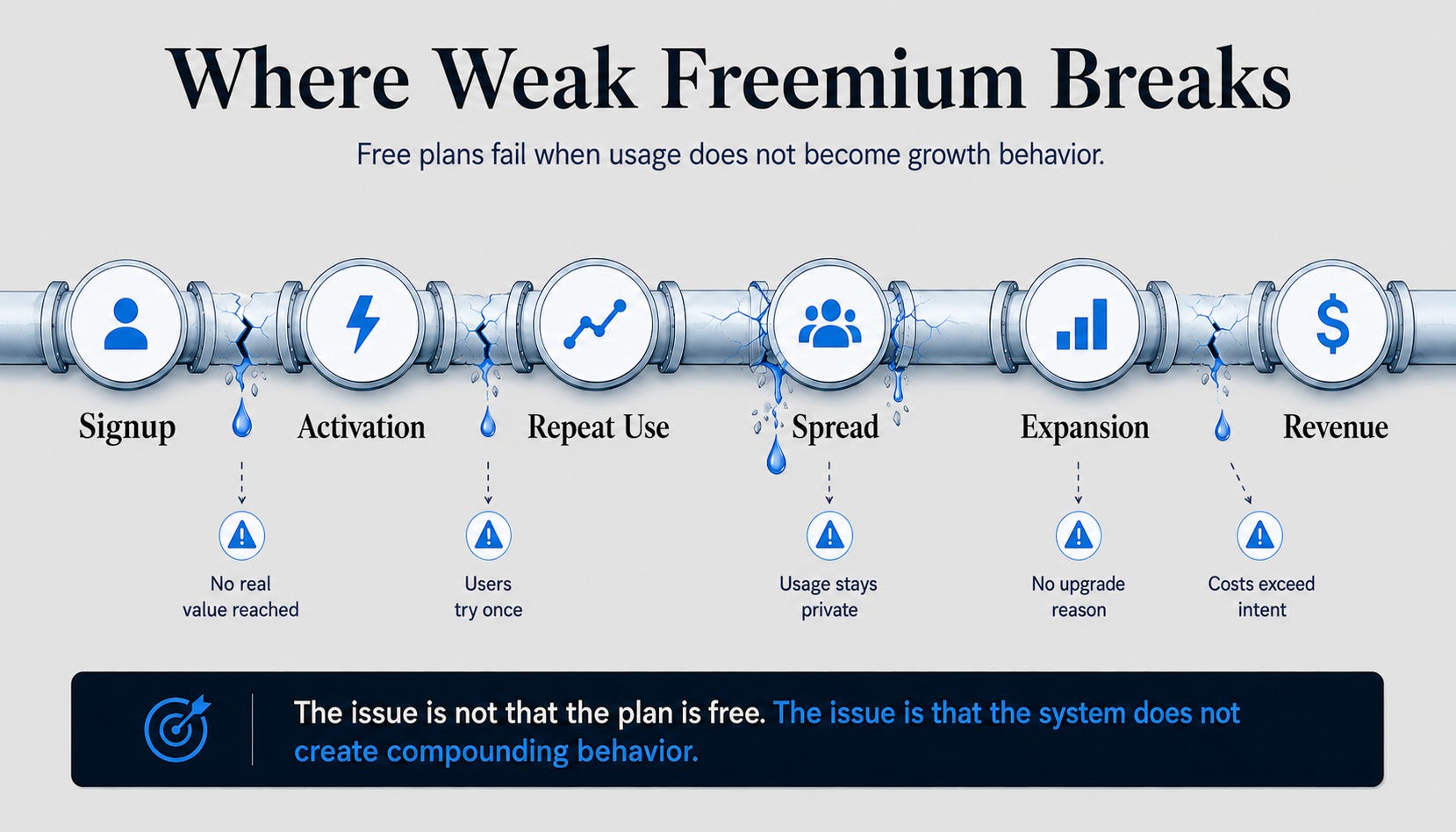
Weak freemium usually does not fail all at once. It gradually becomes clear that the free tier is disconnected from the company’s growth model.
The first break often happens at activation. Users sign up because the product is free, but they do not reach a meaningful outcome. They see the product, but they do not feel the value. The company may interpret this as an onboarding problem, and sometimes it is. But it may also be a strategy problem. The free product may not expose enough of the core value to create conviction.
The second break occurs with repeated use. A user may get value once, but the product does not become part of a recurring workflow. This is a major issue because freemium depends on time. The user needs to return enough times for trust, habit, collaboration, or upgrade pressure to build. If the product is only occasionally useful, freemium may create trial behavior without durable adoption.
The third break happens in the spread. The user gets value privately, alone, and invisibly. That may still be a good product experience, but it is not a strong distribution system. If the free product does not create invitations, shared artifacts, public outputs, stakeholder review, team usage, or internal visibility, it will not generate much product-led demand beyond the individual user.
The fourth break happens at monetization. The free plan either gives away too much of the value or blocks value too early. Both are damaging. If the free tier solves the full problem for the target user, paid conversion becomes optional. If the free tier blocks users from experiencing the product’s real value, conversion becomes unlikely.
The fifth break happens inside the operating model. Free users begin to shape the roadmap even when they are not the best customers. Their feedback is real, but it may not be strategically useful. Product teams can end up building for the loudest free users instead of the highest-value segment.
Freemium models can subtly divert a company's strategy. Initially, it appears to be a growth effort, but over time it becomes a product burden.
The Best Paywalls Follow Value
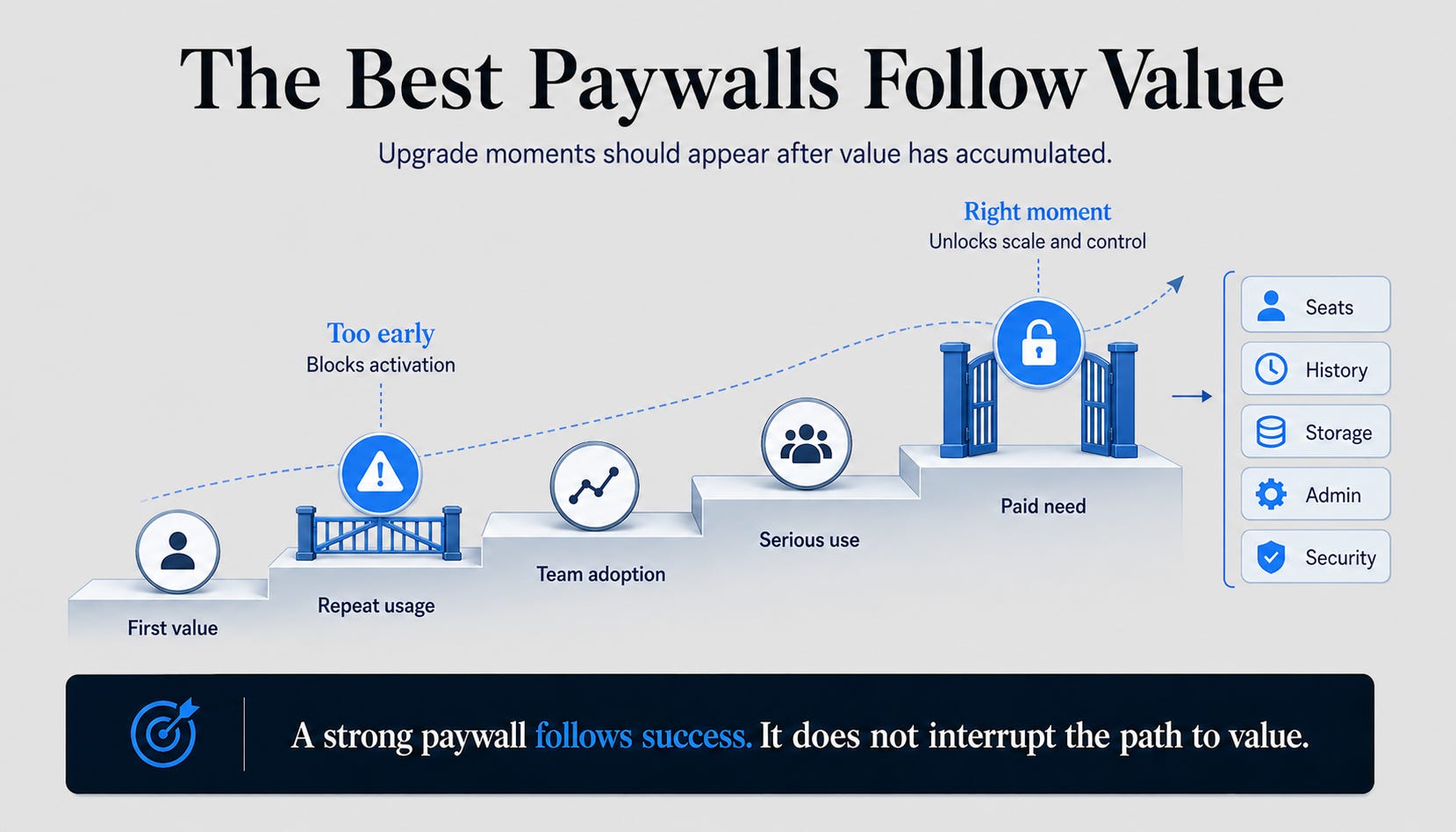
A key indicator of a mature freemium approach is the position of the paywall. Weak paywalls hinder exploration, while strong paywalls are based on accumulated value.
This matters because users don’t mind paying in principle; they object when they pay before understanding the product’s importance or are charged for seemingly arbitrary limits. A robust freemium boundary emerges when the user’s own success creates a new, more advanced need.
For example, a team with extensive Slack history might find losing access to older messages problematic. Similarly, a design team with many Figma projects will find permissions and asset management increasingly critical.
Canva users who create substantial content will value brand kits and collaboration tools, while Dropbox users with large file collections will see increased storage as a natural upgrade. In each case, the paid plan isn’t just a barrier—it’s the next stage of usage.
Many companies miss this point: upgrades should feel like reaching a new level of seriousness, not just paying out of curiosity.
While not every paywall needs to be soft, monetization is essential. The most effective freemium models place charges where the value is already evident, helping users see the need because the free experience has made it clear.
The Freemium Operating Model
If I were advising a product team on freemium, I would not start with the pricing page. I would start with the operating model.
A freemium strategy needs five connected decisions.
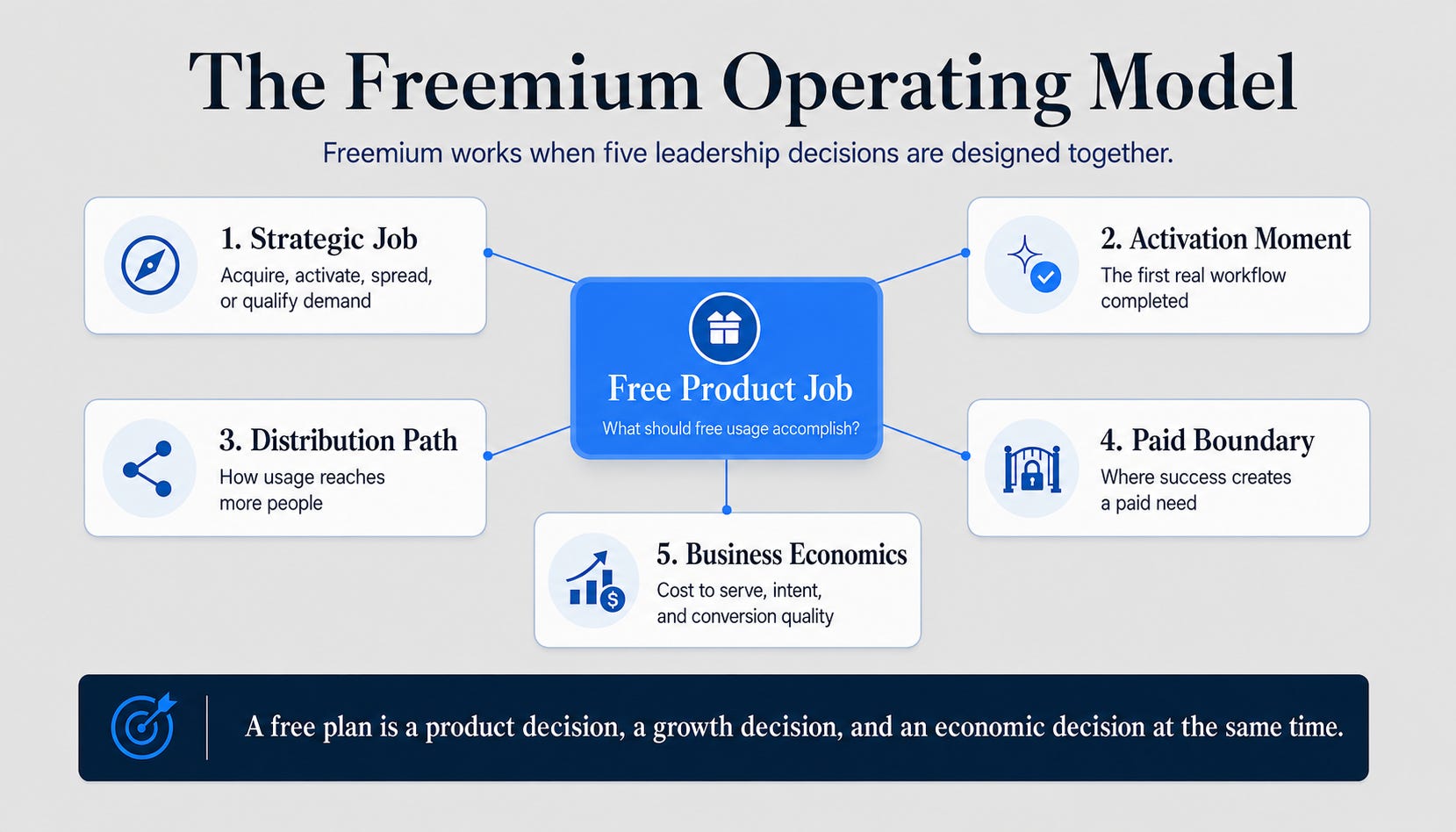
1. Define the strategic job of the free product
The free product should have a clear role in the growth system. It may exist to create individual activation, team collaboration, shared outputs, workflow habit, account seeding, community growth, or ecosystem adoption.
This choice matters because each job requires a different product design.
A free plan built for activation needs to quickly get the user to a meaningful first outcome. A free plan built for collaboration needs invitations and permission flows that feel natural. A free plan built for output distribution requires shared artifacts useful to recipients. A free plan built for account expansion needs product-qualified signals that sales or lifecycle teams can act on.
Most weak freemium motions skip this decision. They define the free tier by features instead of by purpose.
The result is a plan that is easy to explain on a pricing page but hard to defend as a growth strategy.
2. Design activation before packaging
The free product has to deliver the product’s core promise, not just expose the interface.
This is where many companies get too protective. They worry that giving users too much value will reduce conversion, so they restrict the free experience to the point where users never reach conviction.
That is backward.
Before a user pays, the product has to earn belief. The free experience should create a moment where the user understands why the product matters and why they would want to come back.
For Slack, value appears when real team communication starts happening in channels. For Figma, value appears when design work becomes easier to share, review, and collaborate on. For Canva, value appears when a user creates something they can actually use.
Activation isn't just a tour, account setup, or a series of onboarding clicks. It's the initial evidence that the product can enable real progress for the user. Freemium models succeed only when this proof occurs before the user loses interest.
3. Build a natural distribution path
The free product should make it easier for value to move from one person to another.
This does not mean every freemium product needs viral growth. Most B2B products do not spread like consumer networks. But the product should have some path where usage creates exposure, collaboration, or internal demand.
That path may come from inviting teammates, sharing a file, sending a report, publishing a page, assigning a task, requesting approval, embedding a dashboard, duplicating a template, or bringing a stakeholder into a workflow.
The key is that distribution should be connected to the user’s actual work.
This is why forced referrals usually underperform. A referral prompt that appears after signup is not the same thing as a product experience that naturally involves other people. The best distribution moments are not bolted onto the product. They emerge from the job the user is already working on.
Figma did not need to beg designers to invite stakeholders. Collaboration was part of the work.
Slack did not need to convince users that communication involved other people. The product only became useful when the team joined.
Dropbox did not reward users with something unrelated. It rewarded them with additional storage, making the product more useful.
Distribution works best when it feels like a continuation of value, not an interruption.
4. Place paid boundaries where success creates new needs
Freemium monetization works best when the paid plan maps to a natural increase in usage, complexity, or business value.
The upgrade path should be tied to one of several success signals: more people, more data, more work, more storage, more history, more automation, more integrations, more governance, more brand control, more security, or more advanced workflows.
This is why arbitrary feature gating can damage the freemium model. If the free user feels blocked before reaching value, the product loses trust. If the paid plan only unlocks features unrelated to the user’s progress, the upgrade feels disconnected from the experience.
The best-paid boundaries are easy for users to understand because the free product has already created the need.
A team that depends on a history of communication understands why retention matters. A company using design across multiple teams understands why libraries, permissions, and shared systems matter. A business creating branded content every week understands why brand controls and premium workflows matter. A user storing more files understands why more capacity matters.
The upgrade should feel like the next logical step in the customer’s own journey.
5. Manage freemium as a business system, not a marketing campaign
Freemium requires operating discipline.
It is not enough to watch signups and conversions. The company needs to understand which free users are strategically valuable and which are simply consuming resources.
The metrics should reflect the role of the free product. If the free plan is meant to drive activation, measure time to meaningful value, and retained activation. If it is meant to drive collaboration, measure invitations, multi-user workspaces, and active teams. If it is meant to drive output sharing, measure shared artifacts and recipient engagement. If it is meant to seed accounts, measure product-qualified accounts, internal spread, and sales-assist conversion.
The company should also know the cost to serve free users. That includes infrastructure, AI usage, storage, support, abuse prevention, documentation, lifecycle messaging, and product complexity.
This is where freemium becomes a leadership decision, not just a growth experiment.
A free plan can be worth subsidizing when it creates adoption, distribution, learning, or expansion. It becomes dangerous when it primarily generates activity that the company cannot convert into strategic value.
When Freemium Is The Wrong Choice
Freemium is not always the best product-led motion.
Certain products incur high marginal costs, especially when every active user consumes significant AI compute, storage, data processing, or support resources. This can make a broad free tier quickly costly.
Some products also require complex setup processes, such as integrations, migrations, team training, compliance approvals, or workflow redesigns, which can create adoption barriers that free access alone may not overcome.
Additionally, some products experience low repeat usage; sporadic use can hinder habit formation or the urgency needed for conversions.
Products that are inherently private rely on collaboration, shared outputs, stakeholder visibility, or internal dissemination for wider adoption—without these, freemium models may generate trials but lack significant distribution.
Also, a buyer-user gap exists in some cases, where free users find value but lack the budget, authority, or influence to drive organizational adoption.
In those cases, another motion may be stronger.
A free trial can create urgency. A guided pilot can help a complex customer reach value. A sandbox can demonstrate the product without requiring setup. A template library can create a better entry point than a free tier. A sales-assisted product experience can be more effective when value depends on organizational change.
The point is not that freemium is bad. Rather, the point is that freemium is specific.
It works when the free experience can create the conditions for adoption, distribution, and expansion. When it cannot, making the product free may only move the real problem earlier in the funnel.
How Leaders Should Evaluate Freemium
The executive mistake is treating freemium as a yes-or-no decision.
Should we have a free plan?
That question is too shallow.
The better leadership conversation is about fit. A free plan only makes sense if the product has the right conditions for free usage to become valuable over time. The product needs a natural path from free to paid. Usage needs to be repeated. Value needs to spread. The paid plan needs to become more valuable as the customer succeeds.
This is where leaders need to evaluate freemium as a system rather than a pricing tier.
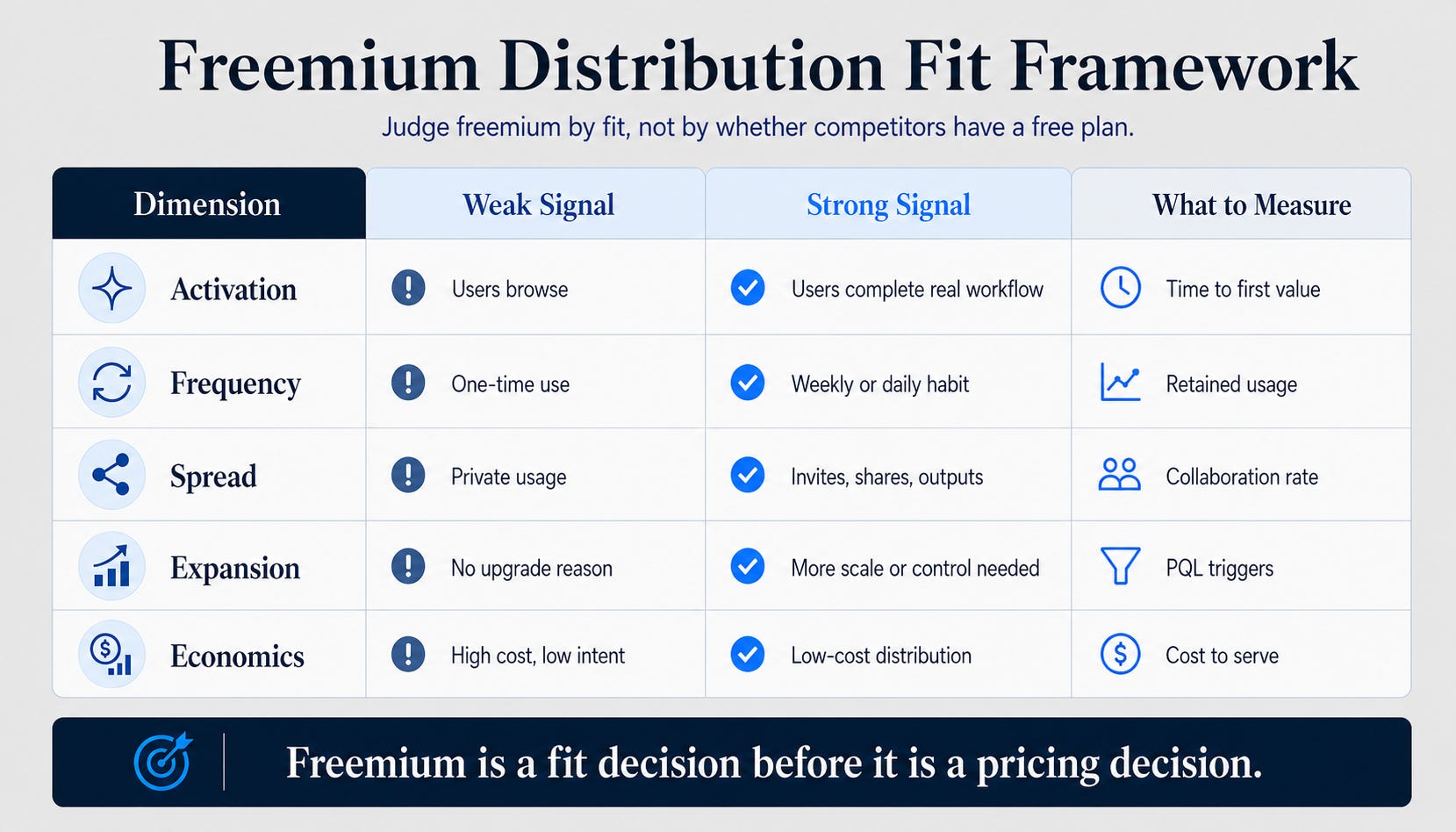
I would look at five dimensions.
The first is activation. Are free users reaching meaningful value, or are they just creating accounts and clicking through onboarding? A strong free plan gets users to a real workflow. They create the report, send the message, publish the page, invite the teammate, build the dashboard, or complete the action that proves the product can help them.
The second is frequency. Does the value repeat? Freemium is much stronger when the product becomes part of a recurring behavior. Daily and weekly products have a greater chance of building habit and trust, and of increasing pressure. If usage is occasional, the free plan may still create awareness, but it will be harder to turn that awareness into durable growth.
The third is spread. Does free usage expose the product to other people? This is where freemium becomes a distribution strategy instead of a free sample. Users might invite teammates, share files, send reports, publish outputs, or bring stakeholders into a workflow. If free use remains private and individual, the company should be honest about it. It may still be a useful acquisition motion, but it is not creating much product-led distribution.
The fourth is expansion. Does success create a natural reason to pay? The best freemium models do not rely on arbitrary paywalls. They create paid demand as usage deepens. More seats, more storage, more history, more permissions, more brand control, more integrations, more automation, or more advanced workflows should become more valuable as the customer succeeds.
The fifth is economics. Does free usage strengthen the business? Free users still have a cost. They consume infrastructure, support, onboarding, documentation, analytics, and product attention. That cost can be worth it if free usage creates learning, pipeline, conversion, expansion, or low-cost distribution. It becomes dangerous when free users create activity without creating future business value.
This is why freemium should not be judged only by free-to-paid conversion.
Conversion is a lagging indicator. By the time a team realizes free users are not converting, the deeper problem has usually been present for months. Activation was weak. Repeat usage was shallow. The product did not spread. The upgrade path did not map to customer success. The economics were never going to work.
A good freemium strategy should show strength before conversion.
You should see free users reaching real outcomes. You should see retained usage. You should see invitations, shared outputs, or collaboration. You should see some accounts getting deeper over time. You should see clear behavioral differences between free users who are likely to pay and free users who are not.
That is how freemium becomes manageable.
The Final Lesson
Freemium is often discussed as if the key issue is how generous to be. How much should we give away? But this perspective misses the main point.
The most successful freemium companies are not accidental in their generosity; they are strategic.
They offer the part of the product that allows the right users to experience value and encourages that value to spread. They don't make the entire product free because free inherently drives product-led growth.
Instead, they make specific features free because these features foster adoption, habit formation, collaboration, sharing, or account growth. Therefore, freemium should be viewed as a growth strategy, not just a pricing tactic.
The pricing page should support the strategy, not define it. If the free offerings help users realize, repeatedly derive, and share value—while also creating a natural desire for paid features—freemium can become a highly effective product-led growth tool.
Conversely, if it only results in more signups, support needs, clutter, and low-quality engagement, it becomes a trap. The core lesson is simple but challenging: freemium isn't about free growth; it's about designing distribution.
Companies that grasp this create free products that expand in markets; those that don't may build free tiers and wonder why their growth never gains momentum.