

The most interesting part of the story is not simply that Calendly had a free plan or solved a common problem. Its real advantage was that using the product naturally introduced it to someone new.
Every time a user sent a scheduling link, another person experienced Calendly’s value. The recipient did not need to sit through a sales demonstration, read a product page, or hear a recommendation. They encountered the product while accomplishing something they already wanted to do: book a meeting.
That is what I call the Calendly Effect.
Calendly did not bolt a referral program onto the product and ask customers to promote it. Distribution was embedded inside the core use case.
The same action that created value for an existing user also exposed a potential new user to the product.
That is one of the most powerful growth loops a product can create.
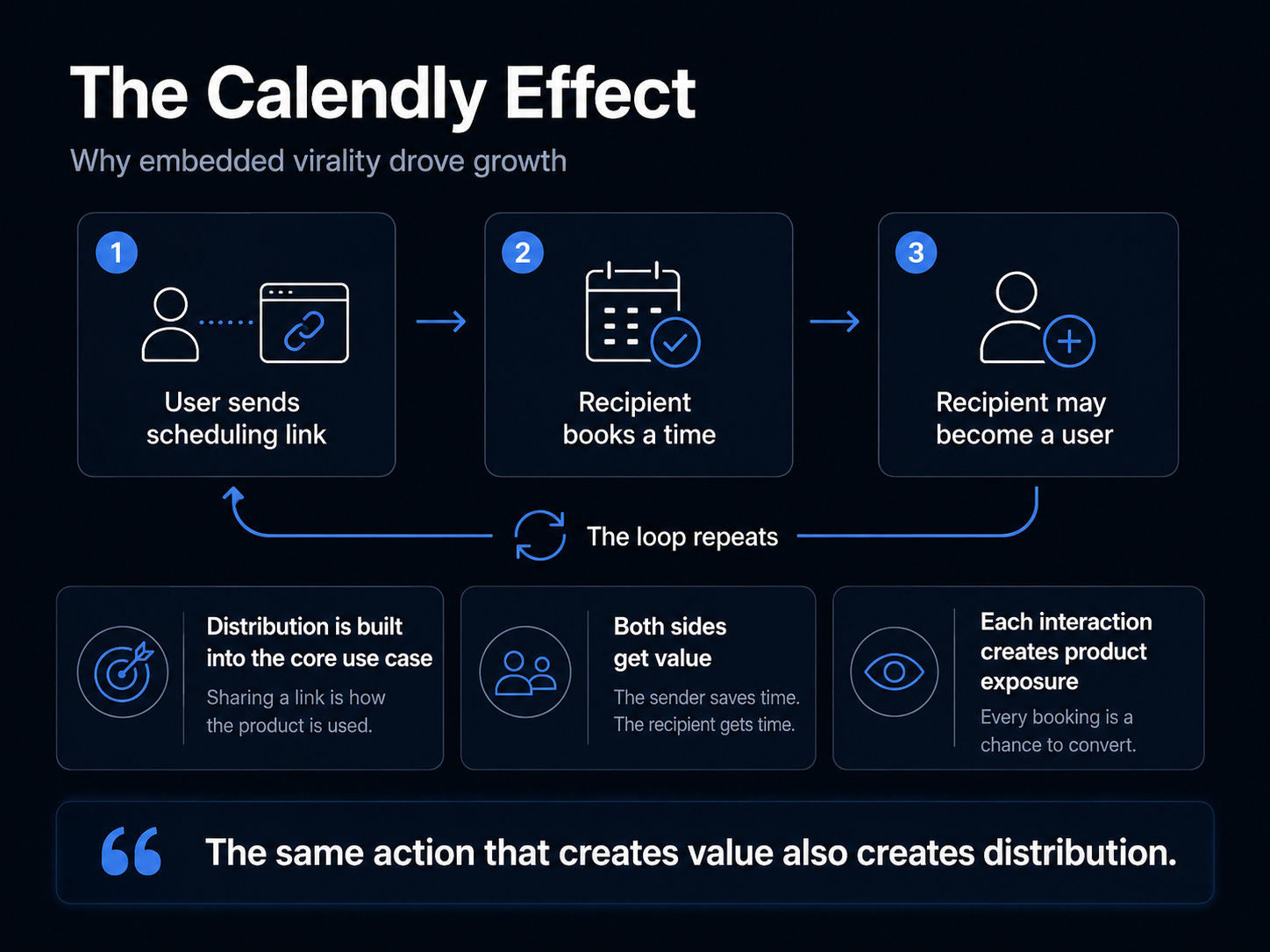
The product action was also the distribution action
Before Calendly, scheduling a meeting often required several messages:
“Are you free Tuesday?”
“Tuesday afternoon could work.”
“How about 2:00?”
“I have something then. Could you do 3:30?”
Calendars already existed. The problem was coordination.
Calendly reduced that coordination to a simple workflow: connect a calendar, define availability, create a meeting type, and send a link. The recipient chooses a time, and the event appears on both calendars.
The value proposition was immediately clear:
Stop negotiating when to meet. Let the other person choose from the times that already work for you.
What made this especially powerful was that Calendly’s core product action was also a distribution action.
To receive value, the user had to share the product. When the recipient opened the link, they experienced the scheduling workflow directly.
The interaction created value for everyone involved:
The sender avoided the back-and-forth.
The recipient quickly booked a convenient time.
Calendly gained exposure to another potential customer.
This is an important characteristic of strong product-led distribution. The new person is not exposed to the product because the company interrupted them with an advertisement.
They are exposed because the product helps complete a shared task.
The product is part of the transaction.
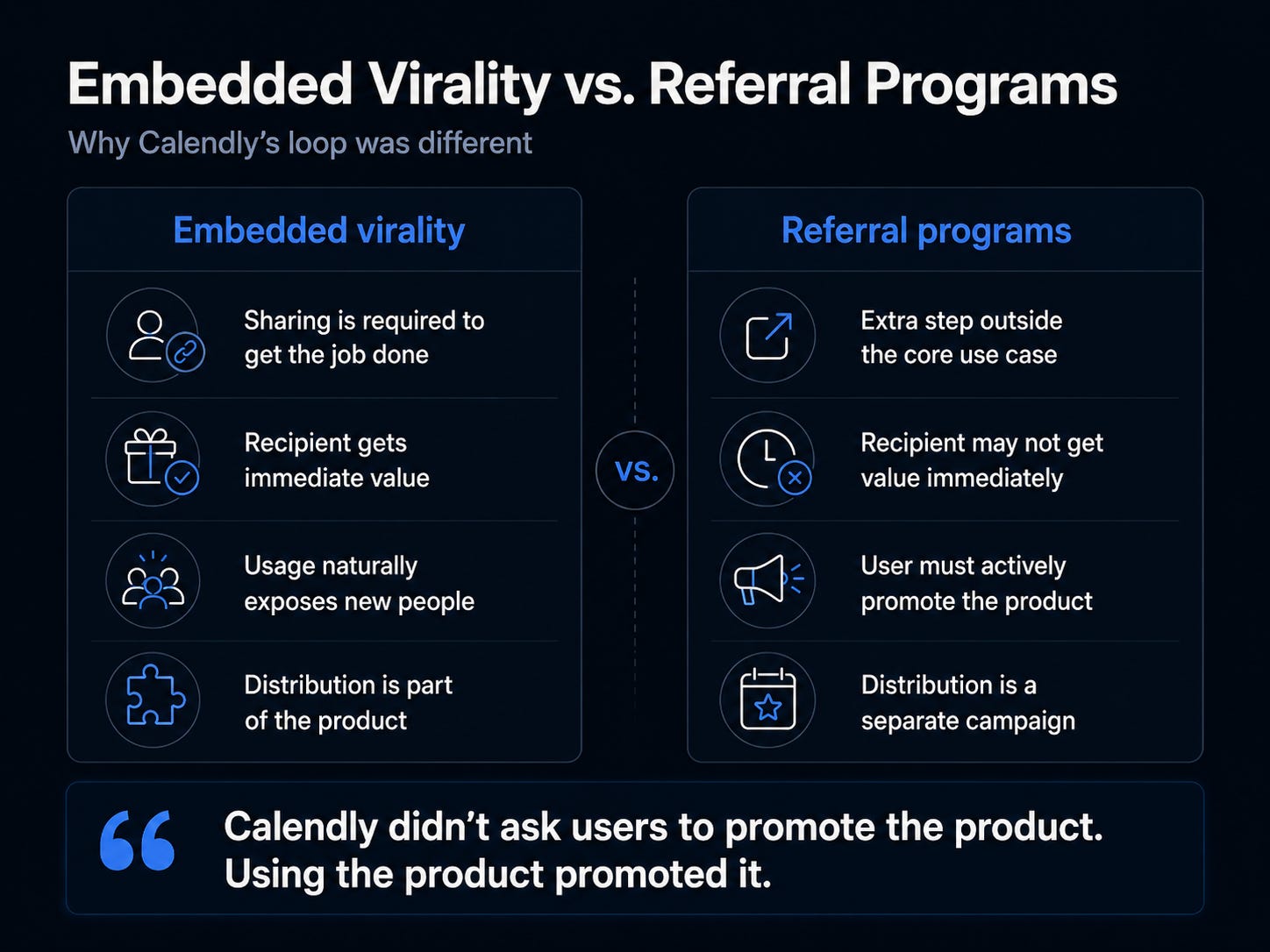
Embedded virality is different from a referral program
Referral programs can be effective, but they work differently from Calendly’s growth loop.
A traditional referral program asks customers to take an additional action outside the core experience:
Refer a friend and receive account credit.
Invite a colleague and unlock a reward.
Share a code to receive more storage.
Post about the product to access a benefit.
The user may participate in the incentive, but referring someone is not typically required to receive the product’s core value.
Calendly did not need that separation.
Sharing was the product.
A user could not automate scheduling without sending a link, embedding a booking page, or otherwise exposing availability to another person. Every successful use of the product therefore created an opportunity for discovery.
The difference is simple:
Referral loop: Use the product, then promote it.
Embedded loop: Use the product, and its very use promotes it.
This does not mean embedded virality fits every business. Some products are private, individual, or invisible by nature. A password manager, personal finance tool, or internal compliance product may not naturally reach other potential users.
But when a product facilitates interaction between people, teams, companies, or market participants, there may be an opportunity to turn that interaction into a distribution channel.
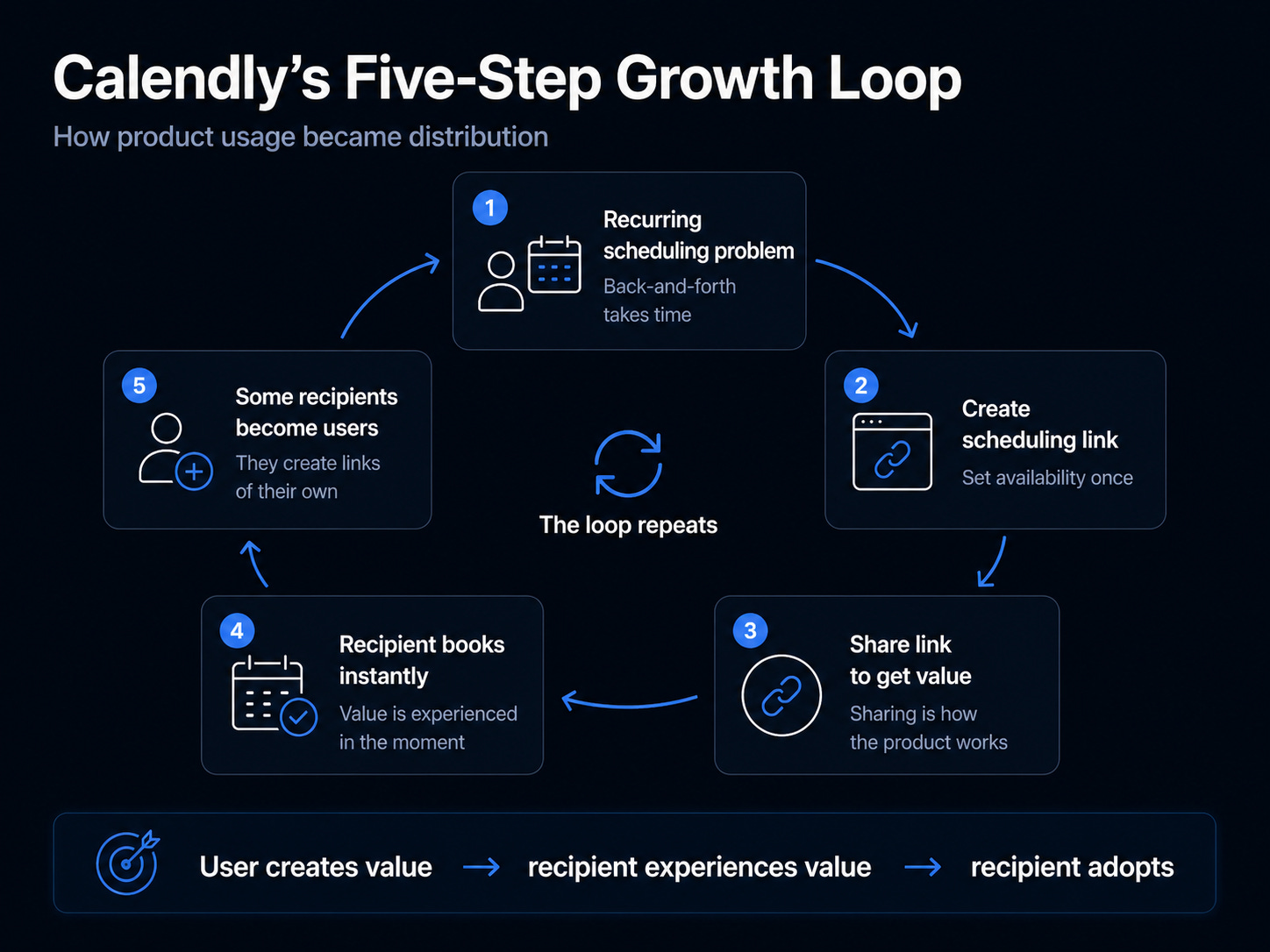
The anatomy of Calendly’s growth loop
Calendly’s loop can be understood in five steps.
1. A user experiences a recurring problem
The user needs to schedule meetings and is frustrated by the effort required to coordinate availability.
This problem happens repeatedly. Recruiters, salespeople, consultants, founders, customer success teams, and interviewers may schedule dozens of meetings every week.
Recurring problems create recurring opportunities for product use.
2. The user creates a reusable scheduling asset
The user connects a calendar, defines availability, and creates a scheduling link.
That link can be placed in emails, social profiles, websites, messages, and automated workflows.
3. The user shares the link to receive value
The user does not share the link because Calendly asks them to promote the company. They share it because doing so is required to schedule the meeting efficiently.
Distribution is aligned with customer intent.
4. The recipient experiences the product
The recipient opens the link, selects a time, and completes the booking.
They understand the value while the scheduling problem is happening. Calendly does not need to explain what it could do because it solves the problem in front of them.
5. Some recipients become users
A portion of those recipients recognize that they also schedule meetings. They create their own accounts, send their own links, and expose the product to more people.
The loop repeats:
User creates value → recipient experiences value → recipient adopts → new user creates more exposure
Not every recipient needs to convert for this loop to be powerful. One active user may send links to dozens or hundreds of people.
The more frequently the core action happens, the more distribution the product generates.
Why Calendly’s loop worked
Simply exposing non-users to a product does not guarantee growth. Calendly combined several conditions that made the loop unusually effective.
The recipient received immediate value
The recipient did not need to create an account, install software, or complete onboarding before receiving the benefit.
They could choose a time and book the meeting.
Virality weakens when recipients must invest significant effort before understanding why the product is useful. The faster the recipient reaches value, the stronger the opportunity for adoption.
The product appeared at a high-intent moment
Calendly did not reach people while they were browsing unrelated content. It appeared while they were actively trying to schedule a meeting.
That context made the product’s value obvious.
Calendly was not asking someone to imagine how automated scheduling might help. It was solving the problem in real time.
The best product exposure often happens inside the problem the product solves.
Both sides benefited
Some growth loops create value primarily for the sender, making the recipient feel like an acquisition target.
Calendly improved the experience for both sides. The sender avoided coordination, while the recipient gained a clear view of available times and could book immediately.
Strong embedded loops are usually reciprocal. Every participant receives enough value to willingly continue the interaction.
Recipients often resembled future users
People receiving Calendly links were often professionals who also scheduled meetings.
A recruiter sent links to candidates, colleagues, and hiring managers. A salesperson sent them to prospects and customers. A consultant sent them to clients and partners.
Many recipients had the same problem as the original user.
Distribution is more valuable when product usage repeatedly reaches people inside the target market.
Adoption was easy
A recipient who recognized the value could create a free account without going through a lengthy sales process or committing to a contract.
This low-friction path allowed the loop to continue.
A heavy purchasing or implementation process would have broken the chain between exposure and adoption.
The action repeated frequently
Scheduling is not a one-time event.
Each new meeting gave the user another reason to share their Calendly link. The product generated repeated exposure without requiring customers to consciously promote the company.
A loop becomes much stronger when the distribution action happens several times per week or per day.
Virality amplified product-market fit
Calendly’s growth loop is compelling, but virality was not the whole strategy.
The company first solved a painful and widely understood problem. The product was easy to explain, quick to adopt, and useful almost immediately.
That product-market fit made the loop work.
A weak product with a viral mechanic may generate exposure, but recipients will not adopt or retain it. A strong product without distribution may retain its early customers but struggle to grow efficiently.
Calendly combined both:
A recurring problem
A simple value proposition
A fast path to value
A free adoption model
A workflow that naturally involved other people
Repeated exposure to similar potential users
The product did not grow simply because it was shareable.
It grew because it was worth sharing.
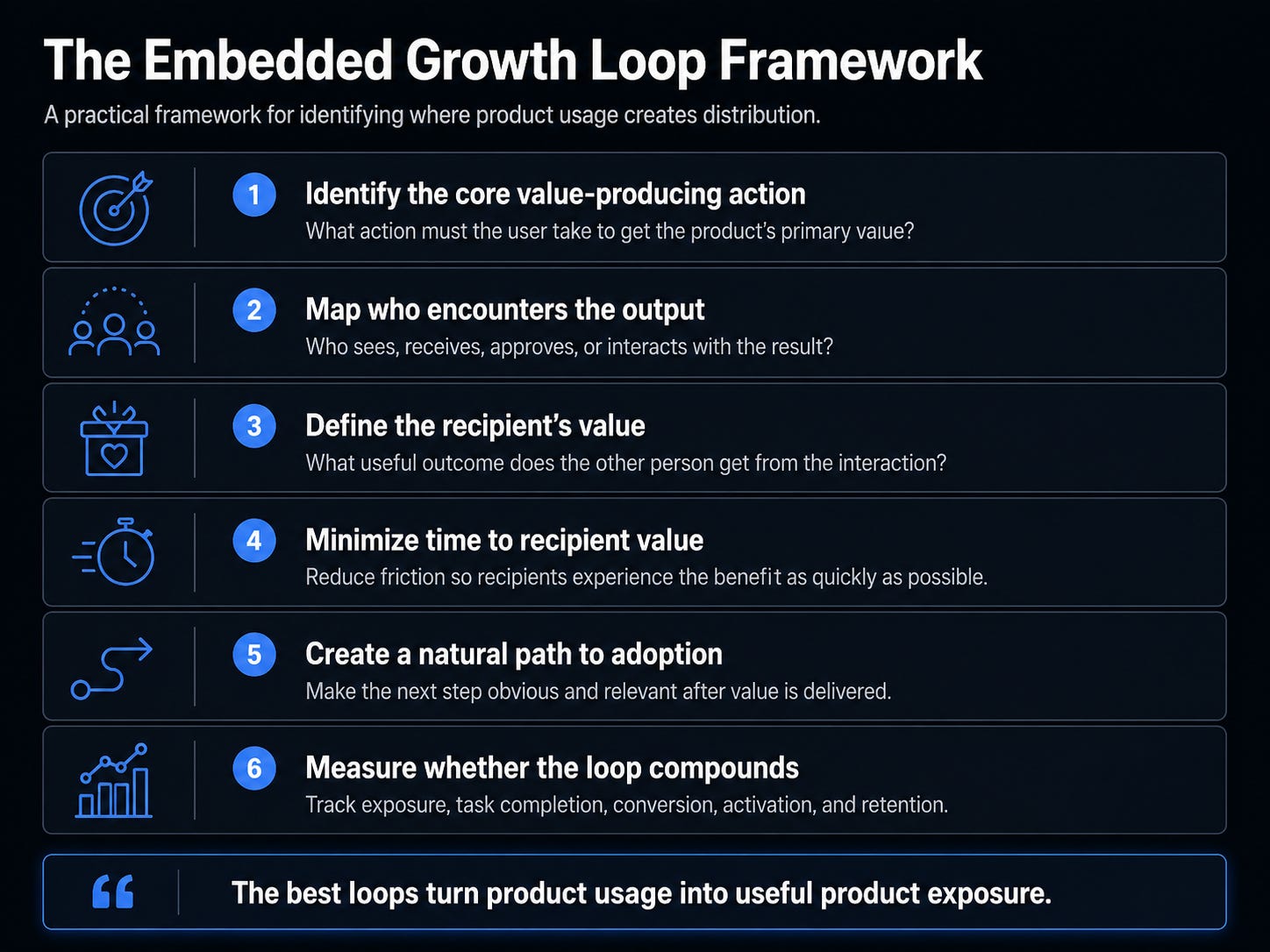
The Embedded Growth Loop Framework
Calendly’s loop cannot be copied literally by every company. But product teams can apply the same underlying principles to identify growth opportunities inside their own workflows.
Step 1: Identify the core value-producing action
Start with the action customers must perform to receive the product’s primary value.
For Calendly, that action was sharing availability so another person could schedule a meeting.
For another product, the action might be:
Sharing a document for review
Sending an invoice
Requesting an electronic signature
Publishing a dashboard
Delivering a design
Sending a payment link
Assigning a task
Sharing an AI-generated output
The action should be central to the customer’s job, not a promotional feature added around the edges.
Step 2: Map who encounters the output
Identify who sees, receives, approves, consumes, or interacts with the result.
Ask:
Does the workflow naturally involve another person?
Is that person inside the target market?
Do they have a similar problem?
How often does the interaction happen?
Does the workflow cross organizational boundaries?
Calendly’s recipients were especially valuable because many of them also had a recurring need to schedule meetings.
Exposure alone is not enough. The product needs to reach people who have a plausible reason to adopt it.
Step 3: Define the recipient’s value
Do not focus only on what the existing user gains.
What does the recipient receive?
For Calendly, the recipient could choose a convenient time without exchanging multiple emails.
For an electronic signature product, the recipient can sign a document quickly.
For a design platform, a stakeholder can comment directly on the work.
For a payment product, the recipient can complete a transaction with less effort.
The recipient should gain real value even if they never become a customer.
When the interaction feels like advertising rather than utility, the loop weakens.
Step 4: Minimize time to recipient value
Measure the friction before the recipient understands the benefit.
Do they need to create an account? Install an application? Verify an email? Request approval? Learn a complicated interface?
Every extra step reduces the strength of the loop.
Calendly allowed the recipient to complete the key task before signing up. The product demonstrated value before asking for commitment.
Step 5: Create a natural path to adoption
After the recipient receives value, what is the most logical next step?
After booking a meeting, they might create their own scheduling page.
After signing a document, they might send one of their own.
After reviewing a dashboard, they might create a workspace.
After viewing a shared AI prototype, they might duplicate and customize it.
The transition should feel like a continuation of the value just received, not an interruption.
Step 6: Measure whether the loop compounds
A loop only matters if it produces retained users.
Track:
External recipients reached per active user
Recipient task completion
Recipient-to-user conversion
Activation after sign-up
Retention of users acquired through the loop
Which use cases produce the highest-quality adoption
The goal is not simply to maximize exposure. A loop that creates many low-quality registrations may be less valuable than one that produces fewer but more qualified users.
What the Calendly Effect looks like in other products
The same pattern appears in several product categories.
Collaborative documents
A user creates a document and shares it with coworkers, clients, or stakeholders. Recipients can view, comment on, or edit within the product.
The shared output becomes the distribution channel.
The loop strengthens when recipients can access value before creating an account and when collaboration makes the document more useful to the original user.
Electronic signatures
A sender requests a signature. The recipient completes the workflow without first becoming a customer.
Every agreement demonstrates the product to another potential user. Some recipients later adopt it when they need to send their own documents.
Payment products
A business sends a payment link, invoice, or checkout experience. The customer interacts directly with the product while completing a transaction.
Recipients who also need to collect payments may become future users.
AI products
A user may share a generated report, prototype, application, analysis, presentation, or interactive agent.
The opportunity is not simply to place a logo on the output. The recipient must understand how the product helped create something useful and have a clear path to create or customize their own version.
A branded image is not automatically a growth loop.
An interactive prototype that a recipient can duplicate, adapt, and publish may be.
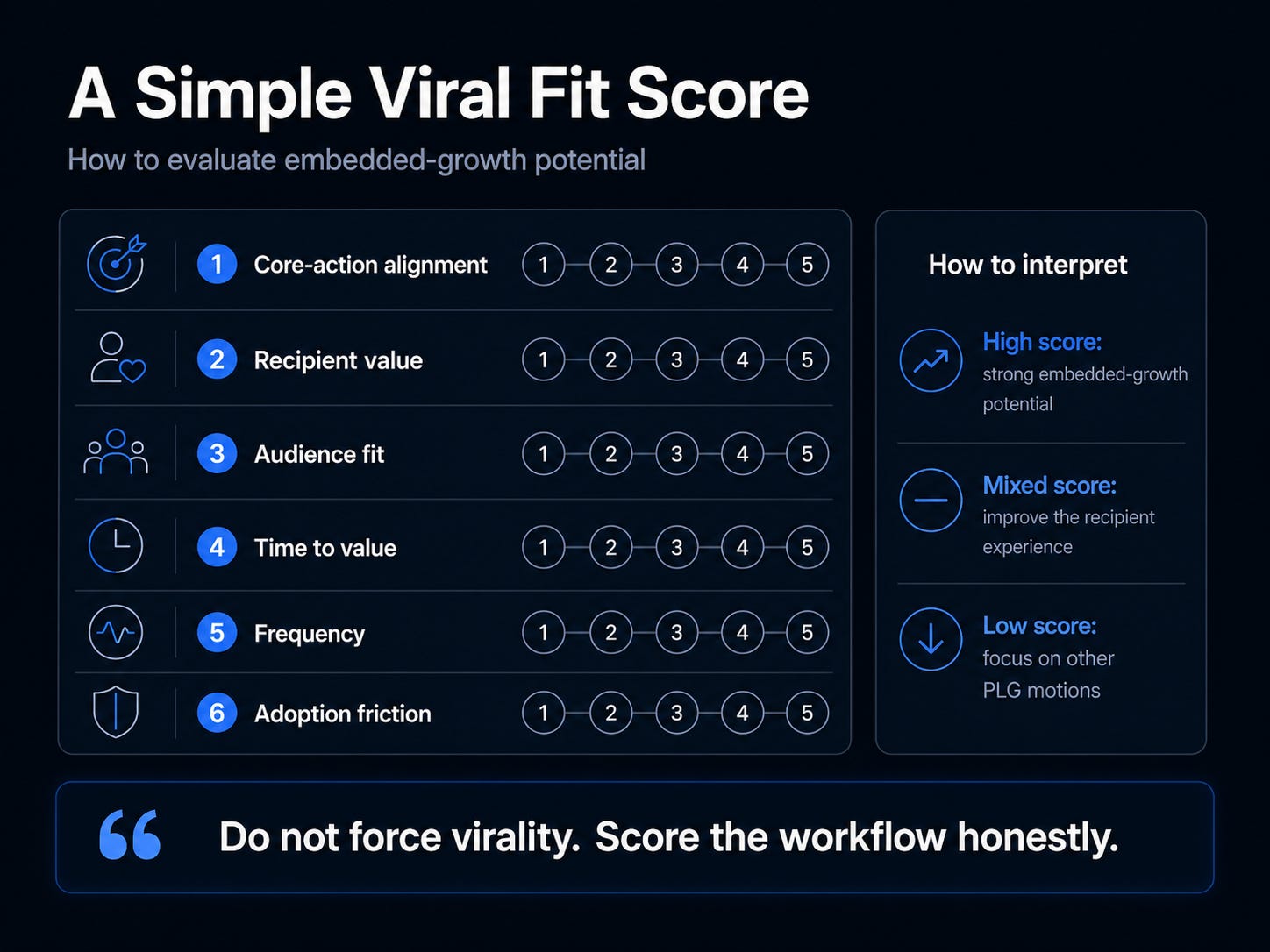
A simple Viral Fit Score
Product teams can evaluate embedded-growth opportunities across six dimensions.
Score each from one to five.
1. Core-action alignment
Is the external interaction necessary for the product to deliver its primary value?
2. Recipient value
Does the recipient receive a clear and immediate benefit?
3. Audience fit
How closely does the recipient resemble a potential future user?
4. Time to value
How quickly does the recipient understand and experience the benefit?
5. Frequency
How often does an active user generate this exposure?
6. Adoption friction
How easy is it for an interested recipient to start using the product?
A high score suggests strong embedded-growth potential.
A low score does not mean the product cannot use PLG. It may mean the company should focus more heavily on activation, retention, usage-based expansion, integrations, templates, community, or sales-assisted growth instead of trying to force virality.
Improve recipient value before optimizing conversion
Many products already expose themselves to non-users, but the experience is not designed intentionally.
A report may arrive as a static attachment with no connection to the product that created it. A project invitation may require account creation before the recipient understands why they were invited. A shared AI output may be impossible to customize or reuse.
Improving the loop does not necessarily mean adding louder branding or more aggressive sign-up prompts.
It often means making the shared experience more useful.
Ask:
Can the recipient complete the task without creating an account?
Is the benefit understandable within seconds?
Does the shared experience show the product at its best?
Can the recipient comment, approve, customize, or duplicate?
Is the next step relevant to what they just accomplished?
Does the experience work well on mobile and in the browser?
Does the sender retain control over what is shared?
The best growth optimization may be improving the artifact or workflow itself.
When recipient value improves, conversion can become a consequence rather than the primary goal.
Do not manufacture virality
Calendly’s loop looks obvious in retrospect, which can tempt companies to force sharing into products where it does not belong.
That usually produces poor experiences.
Common mistakes include:
Requiring users to invite teammates before receiving value
Adding promotional watermarks to private outputs
Asking for referrals immediately after account creation
Gating functionality behind social sharing
Sending notifications without clear permission
Turning sensitive activity into public content
Adding collaboration to a product that is valuable precisely because it is private
The goal is not to make every product viral.
The goal is to identify where value already crosses from one person to another and improve that exchange.
Some products are naturally private or single-player. Their best PLG motions may involve free trials, templates, integrations, developer ecosystems, usage-based expansion, community, or bottom-up adoption inside an organization.
Do not copy Calendly’s link.
Copy the principle of aligning product value with product distribution.
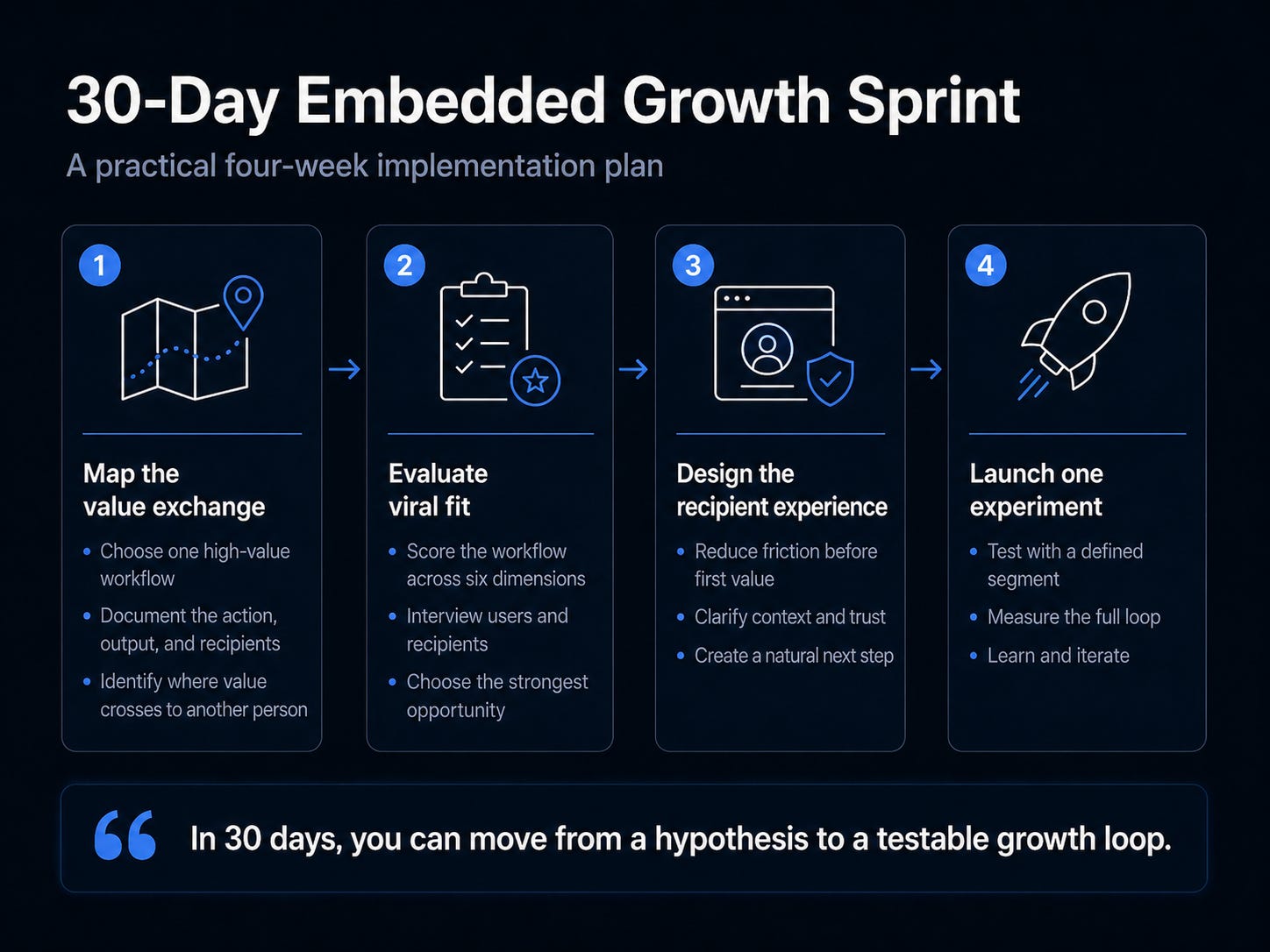
A 30-day Embedded Growth Sprint
A focused four-week sprint can help a product team identify and test its strongest opportunity.
Week 1: Map the value exchange
Choose one high-value workflow.
Document:
The user’s goal
The action they perform
The output created
Who encounters that output
The value each participant receives
How often does the interaction happen
Where friction appears
Identify three moments where product value naturally crosses to another person.
Week 2: Evaluate viral fit
Score each opportunity using the six Viral Fit dimensions:
Core-action alignment
Recipient value
Audience fit
Time to value
Frequency
Adoption friction
Select the strongest opportunity and observe the current workflow. Interview both senders and recipients.
The recipient's perspective is critical. An experience that feels simple to the customer may be confusing or burdensome to the person on the other side.
Week 3: Design the recipient experience
Prototype an improved version of the shared workflow.
Focus on immediate context, clear value, minimal setup, trust, fast task completion, and a relevant next step after the task is complete.
Avoid making sign-up the first requirement unless security or functionality makes it necessary.
The prototype should answer one question:
Can the recipient experience enough value to understand why they might use the product themselves?
Week 4: Launch one experiment
Test one improvement with a defined customer segment.
Examples include:
Allowing recipients to comment without creating an account
Making a shared report interactive
Adding a “create your own” path after completion
Allowing a recipient to duplicate a template
Improving invitation context
Removing a sign-up barrier before first value
Making an AI-generated output customizable
Measure the full loop:
Exposure
Recipient task completion
Recipient satisfaction
Account creation
Activation
Retention
Impact on the original user
Do not improve recipient conversion by making the sender’s experience worse.
A healthy loop creates value for both sides.
<image: 30-Day Embedded Growth Sprint graphic>
The real lesson from Calendly
Calendly’s growth was not driven by a clever referral incentive.
It was driven by structural alignment between product value and product distribution.
The user needed to share the product to solve the scheduling problem. The recipient benefited from the interaction. Many recipients had the same problem. A free plan allowed interested people to adopt quickly. Repeated scheduling created repeated exposure.
Every part of the system reinforced the next.
That is why the Calendly Effect is more useful than a single growth tactic.
It gives product leaders a better question to ask.
Instead of:
How can we convince customers to refer more people?
Ask:
Where does the value of our product naturally cross from one person to another, and how can we make that experience useful enough to create adoption?
The answer might be a document, an approval, a transaction, a report, a design, an AI output, a collaboration request, or a customer-facing workflow.
It may not exist in every product.
But when it does, it can turn ordinary customer activity into a durable distribution channel.
The strongest product-led companies do not make customers choose between using the product and spreading it.
They design the product so that creating value naturally does both.