

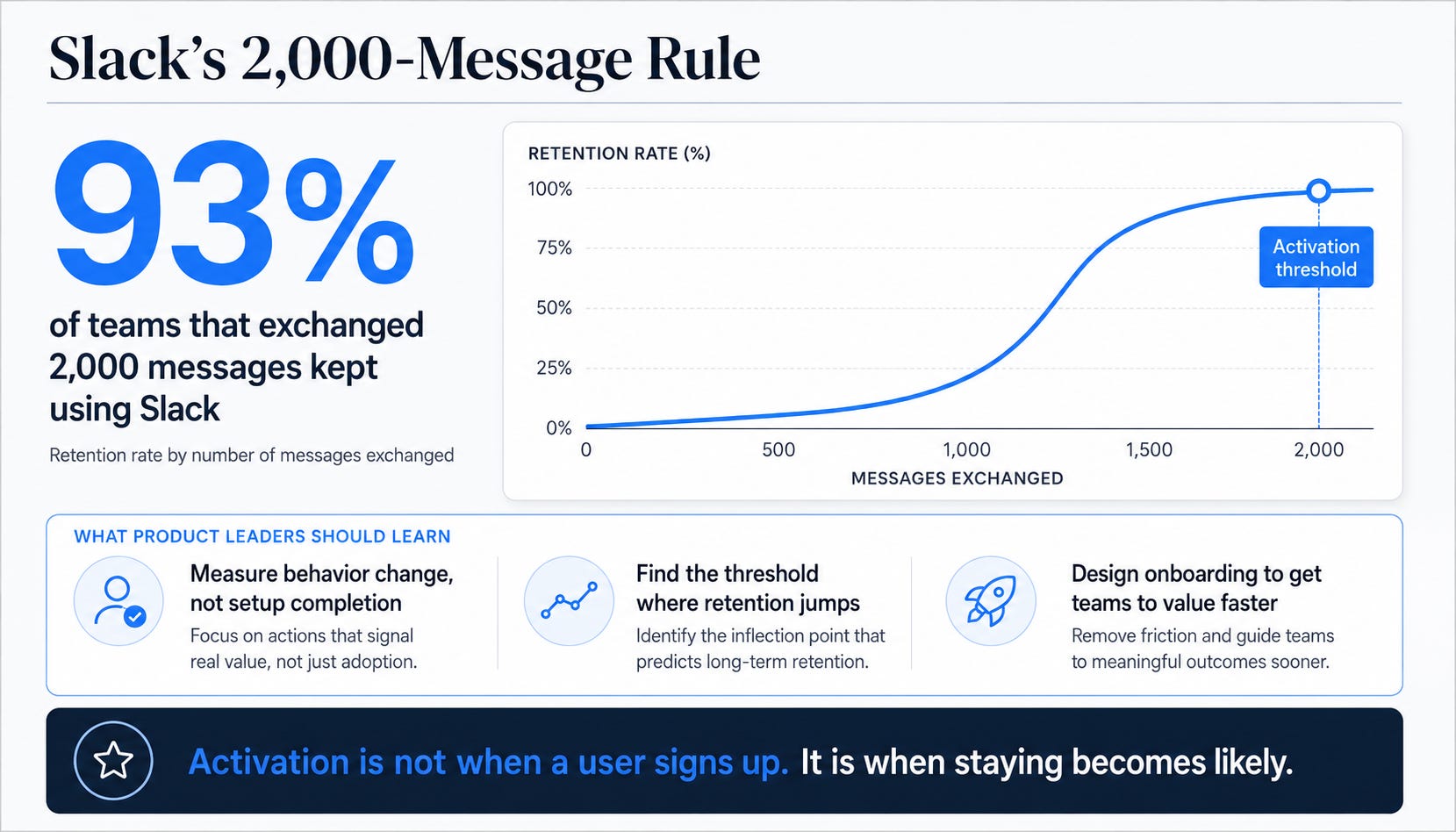
In Slack’s early days, the company discovered a remarkably strong signal in its customer data: once a team had exchanged 2,000 messages, 93% of those teams continued using the product.
Creating a workspace was not enough. Sending a first message or inviting a coworker was not enough either. Those actions showed that someone had started using Slack, but they did not reliably indicate that the product had become valuable enough for the team to stay.
The 2,000-message threshold was different. By the time a team reached it, Slack was no longer another communication tool being tested alongside email. It had started to become part of the team’s normal operating rhythm.
That discovery is one of the most useful examples of product-led growth because it shows what activation should actually measure. Activation is not simply the completion of onboarding. It is the point at which customers have experienced enough meaningful value to make continued usage substantially more likely.
Most companies understand that activation matters, but many define it too early in the journey. They choose an action that is easy to instrument, such as creating an account or using a core feature once, and treat it as evidence that the customer has reached value.
Slack took a more rigorous approach. It examined the behavior of teams that stayed, identified the threshold separating them from those that left, and used that insight to focus the product experience on meaningful adoption.
What Slack’s 2,000-message threshold really represented
The important part of Slack’s discovery was not the number 2,000. Message volume was simply the observable signal that a deeper behavioral shift had taken place.
A team that had exchanged 2,000 messages had probably done much more than send a large number of chats. It had invited coworkers, created channels around real projects, shared files, searched previous conversations, and moved at least some important communication away from email.
The workspace was accumulating useful history. Team members were building new habits. People increasingly had a reason to open Slack: their coworkers and the information they needed were already there.
This created a reinforcing loop. As more people participated, more conversations and knowledge accumulated. As more knowledge accumulated, Slack became more useful. As Slack became more useful, teams moved more work into it.
The product was no longer generating isolated interactions. It was becoming part of the team’s workflow.
That distinction is critical. A good activation metric should not merely indicate that customers are busy inside a product. It should indicate that they are receiving the value the product was designed to provide.
For Slack, message volume was a strong proxy for collaborative adoption. For another product, the relevant signal might be completing workflows, publishing content, receiving feedback, deploying software, processing transactions, or repeatedly returning to a report.
The metric will be different in every business, but the principle is consistent:
The best activation signals represent a real customer outcome, repeated deeply enough to predict retention.
Why most activation metrics are too shallow
Many SaaS companies define activation as the earliest event that resembles value. Common examples include completing onboarding, uploading a file, connecting an integration, creating a project, inviting a teammate, or generating an AI response.
These events are useful because they show whether customers are progressing through setup. The mistake is assuming that setup and value are the same thing.
Consider an AI content platform. A new user enters a prompt during onboarding and generates one article. The company could record that event as an activation because the user successfully accessed the core feature.
But imagine that the user dislikes the result, never edits it, never publishes it, and never returns. Technically, the user is activated. In practical terms, the product failed.
Now consider a customer who generates five pieces of content, meaningfully edits two, exports one into a campaign, and returns the following week to create another asset. That behavior provides much stronger evidence that the product has become useful.
The same distinction applies across product categories.
For a project management platform, creating a project is setup. Coordinating and completing real work with teammates is valuable.
For an analytics product, the data source connection is set up. Building a report that regularly informs decisions is valuable.
For a CRM, importing contacts is setup. Advancing real opportunities through the pipeline is valuable.
For a developer platform, creating an API key is setup. Successfully running production traffic through the product is valuable.
The practical question is not “Did the customer use the product?”
It is: “Did the customer use the product in a way that demonstrates the intended value proposition?”
Slack’s threshold answered that second question.
Activation connects product-market fit to product-led growth
Product-market fit describes the value customers want. Activation is the behavioral evidence that they have begun to receive that value. Product-led growth is the system that helps more customers reach it.
Without a reliable activation metric, a company can improve the top of its funnel while weakening the business underneath it. Sign-ups may increase while retention falls. More users may complete onboarding, while fewer integrate the product into real workflows.
This is why activation should be connected to retention rather than defined by product intuition alone.
A product manager may believe that creating a dashboard is the critical moment in an analytics product. But the data might show that dashboard creation has little relationship to retention, while sharing the dashboard with a second active user predicts a significant increase.
That insight changes the product strategy. The team should not simply make dashboard creation easier. It should help customers create something useful enough to share, making sharing part of the core journey.
A strong activation metric reveals not only whether customers are reaching value, but also how the product should help them get there
A practical formula for defining activation
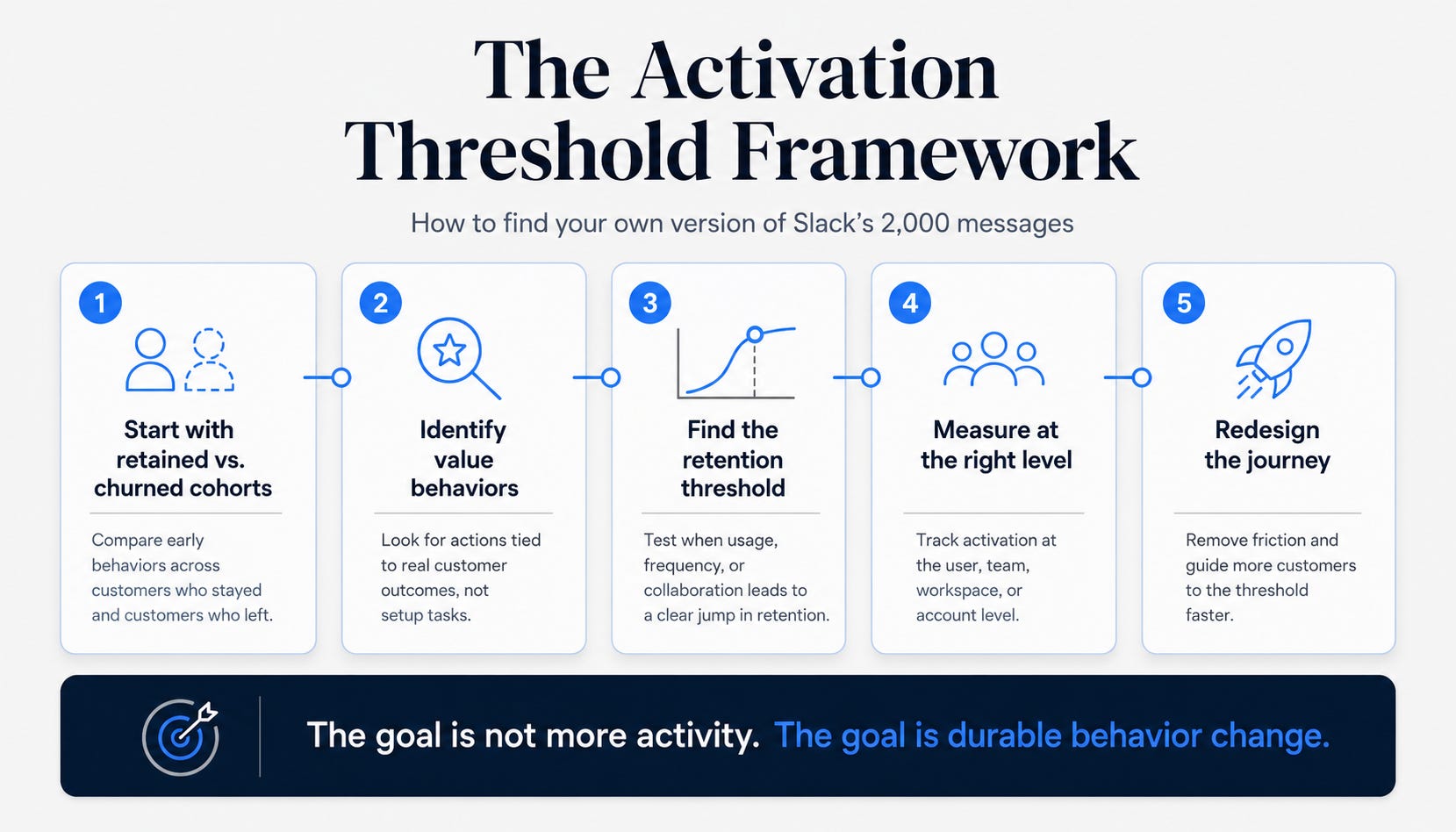
A useful activation definition usually contains four components:
Activation = value behavior + frequency + participation + time window
The value behavior describes the action that produces a meaningful customer outcome.
Frequency refers to how often the behavior needs to occur before it becomes meaningful.
Participation specifies how many users, teams, workflows, or objects must be involved.
The time window establishes how quickly customers should reach the milestone.
For an AI content platform, activation might mean:
Generate five assets, meaningfully edit two, and export or publish one within seven days.
For a project management platform:
Complete three tasks inside a shared project with at least three active teammates within ten days.
For a product analytics platform:
Connect production data, create two reports, and have a second user view an insight within fourteen days.
For a developer platform:
Deploy one application, process 100 successful requests, and add a second developer within twenty-one days.
These definitions are much more useful than broad statements such as “the customer experienced value” because they translate value into observable behavior
How to find your own activation threshold
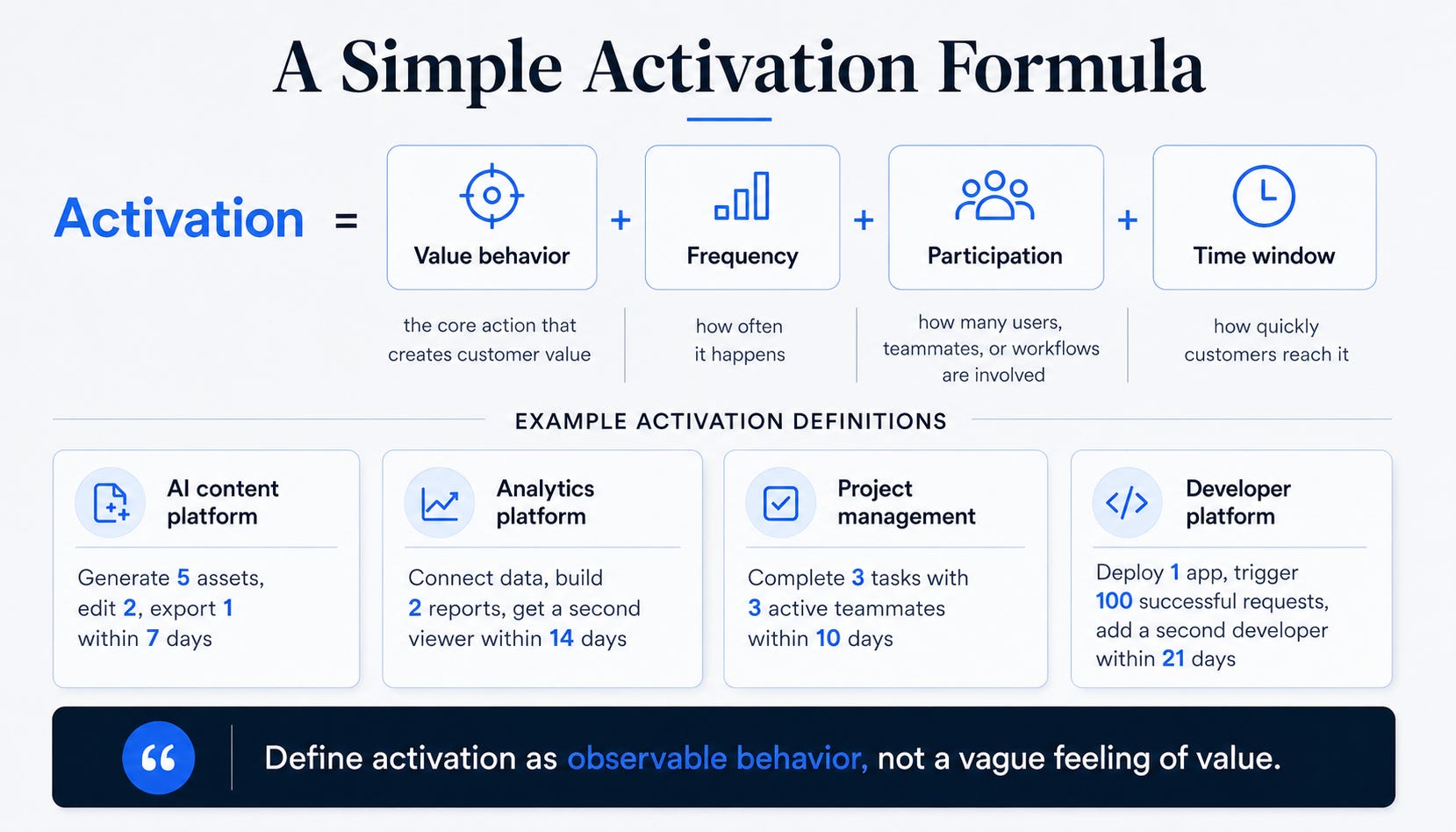
Finding your version of Slack’s 2,000 messages requires more than picking a popular feature and calling it activation. It is both an analytical exercise and a product discovery process.
Step 1: Choose a customer segment and define retention
Before analyzing product behavior, decide whose activation you are measuring.
A five-person startup may adopt the product differently from a large enterprise. An administrator may have a different path to value from an end user. A marketing team and an engineering team may use the same platform for completely different jobs.
Choose one meaningful segment first. Trying to create a universal activation metric across all customer types often yields a definition too vague to guide the product.
Next, define retention according to the product’s natural usage cycle.
Weekly activity may be appropriate for Slack, but it would be a poor measure for payroll software, which customers use only twice per month. A planning product may be used only quarterly, whereas a security platform may create value continuously, even when few users log in.
Retention might mean that the customer is still active after 90 days, completes three consecutive business cycles, converts from free to paid and remains active, or expands into another team or use case.
The activation metric should predict an outcome that is meaningful to the business and appropriate for how customers naturally use the product.
Step 2: Compare retained and churned cohorts
Once the target segment and retention outcome are clear, the next step is to compare customers who stayed with customers who left.
The goal is not simply to see which features retained customers used. That is too shallow. The more useful analysis is to understand how behavior developed over time: what customers did first, how often they came back, whether usage deepened, and whether the product started to involve other people or workflows.
For example, a workflow automation company might see a pattern like this:
Customers who only created an account were retained at 14%.
Customers who built one automation were retained at 27%.
Customers who activated one automation were retained at 41%.
Customers who ran 10 successful automations were retained at 63%.
Customers who ran 10 automations across two workflows were retained at 77%.
Customers who added a teammate and ran 10 automations were retained at 87%.
This changes how the team should think about activation.
Creating an account is not activation. Building one automation is a better signal, but it still may not be enough. Even activating one automation may only prove that the customer understood the setup flow.
The stronger signal appears when the customer runs multiple successful automations. At that point, the product is no longer just something they tried. It is starting to produce repeated values.
The signal becomes even stronger when usage expands across multiple workflows or when another teammate is involved. That suggests the product is moving from an individual experiment into a broader business process.
This kind of analysis does not give the team the full answer, but it shows where to look.
The data tells you which behaviors are associated with retention. Customer research helps explain why those behaviors matter.
Step 3: Identify behaviors tied to real value
Candidate activation behaviors should directly connect to the job that customers hire the product to perform.
Most useful candidates involve some combination of creation, consumption, collaboration, integration, and repetition.
A customer may create something valuable, use an insight, involve another participant, connect the product to an existing system, or repeat the behavior enough times that it becomes routine.
The strongest activation definitions often combine several of these.
A design platform may find that creating one design has little predictive value, but creating a design, receiving comments from two collaborators, and publishing a revised version strongly predicts retention.
A customer support platform may find that connecting an inbox is not enough, but resolving 25 conversations with at least three participating agents is a strong signal.
The goal is to identify the beginning of a repeatable customer workflow, not simply the completion of a setup task.
Step 4: Find the point where retention changes
Once you identify candidate behaviors, test them at different levels.
Do not ask only whether customers shared a report. Compare customers who shared 1, 3, and 10 reports. Examine whether one person or several people viewed the reports and whether customers returned to them once or repeatedly.
You are searching for an inflection point where retention materially improves.
Suppose customers who create one dashboard have 30% retention, and those who create three have 34% retention. The difference may not be meaningful enough to organize the product around.
But if customers who create three dashboards and share one with another active user retain at 71%, that combination deserves attention.
The milestone should also occur early enough for the product team to influence it. A behavior that appears after six months may predict renewal, but it will not help improve onboarding.
Slack’s threshold was valuable partly because teams could reach it relatively quickly. That created a window in which product guidance, lifecycle communication, or customer support could accelerate customers toward the milestone before disengagement became permanent.
Step 5: Validate the threshold through experiments
A behavior can correlate with retention without causing it.
Highly motivated customers may naturally use more features, invite more coworkers, and stay longer. Simply forcing less-engaged customers to mimic those actions may not create the same result.
The best way to validate a candidate threshold is to change the product experience and see whether helping more customers reach the behavior improves downstream retention.
If accounts that invite three teammates retain longer, improve the invitation experience, and connect it to a real workflow. If customers who complete three workflows are more durable, introduce templates that help new users complete those workflows faster.
Then measure not only whether more customers reach the behavior, but also whether they retain at a higher rate.
Activation should be treated as a testable model of customer value, not a permanent truth.
Turn the activation threshold into a PLG strategy.
Discovering an activation threshold is only useful if it changes what the organization does.
Slack’s insight reframed the growth problem. Instead of focusing only on creating more workspaces, the company could ask a more valuable question:
How do we help more qualified teams reach 2,000 messages?
That question gives the customer journey a clear objective. Onboarding, invitations, integrations, notifications, lifecycle messaging, and customer support can all be evaluated by whether they help customers achieve meaningful adoption faster.
There are three major levers product teams can use.
1. Reduce time to first value
Generic onboarding often asks every customer to complete the same setup steps, regardless of the outcome they are trying to achieve.
A better approach begins by identifying the customer’s intended use case. A project management platform might ask whether the customer is planning a launch, managing a software sprint, running a marketing campaign, or coordinating client work.
The product can then recommend a relevant template, preconfigure the workspace, and guide the customer through a realistic workflow.
AI-assisted setup can reduce friction further. A CRM might generate pipeline stages based on the customer’s sales motion. A project platform could create a launch plan from a short description. An analytics product could build an initial dashboard based on the data source the customer connects to.
The goal is not to teach every feature. It helps customers complete a meaningful workflow with as little effort as possible.
2. Create the conditions for a repeated value
The first value matters, but repeated value turns a successful experience into a habit.
Product teams should identify what needs to happen again for the customer to continue receiving value. That may involve recurring reminders, integrations, automated triggers, saved workflows, scheduled reports, or additional participants.
Lifecycle messaging should also be based on behavior rather than elapsed time alone.
A customer who has connected data but has not created a report needs different guidance from one who has created a report but has not shared it. An account with invited users but no active collaborators needs a different intervention from one that has already adopted the core workflow.
Instead of sending generic “Day 3 of your trial” emails, send messages connected to the next missing value behavior.
For example:
Your data is ready. Build your first decision-ready report.
Your project is configured. Assign the first three tasks to begin execution.
You have completed two workflows. Run one more to establish the recurring process.
Your team is active. Connect the CRM to bring live customer data into the workspace.
This makes the customer journey responsive to progress rather than time.
3. Accelerate collaboration and high-intent accounts
Collaboration is often essential for activation, but many products ask customers to invite teammates too early.
“Invite your team” can create social friction when the customer has not yet formed an opinion of the product. A better approach is to connect the invitation to a specific outcome.
Prompt the customer to share a completed report with someone who needs the insight, assign a task to the person responsible for the next step, request feedback on a draft, or invite the approver required to complete the workflow.
This turns collaboration into part of accomplishing the customer’s job rather than a generic growth tactic.
Human assistance also has a role. Product-led growth does not mean human-free growth.
A high-value account that shows strong intent but stalls before activation may be an ideal candidate for sales or customer success support. A large organization may invite dozens of users but fail to complete identity configuration. A developer may complete a test deployment but encounter a security obstacle before production.
These signals reveal both intent and the specific barrier preventing progress.
The product should handle the repeatable path to value. People should help with complexity, organizational change, risk, and high-value exceptions.
Use an Activation Ladder to diagnose where customers stall
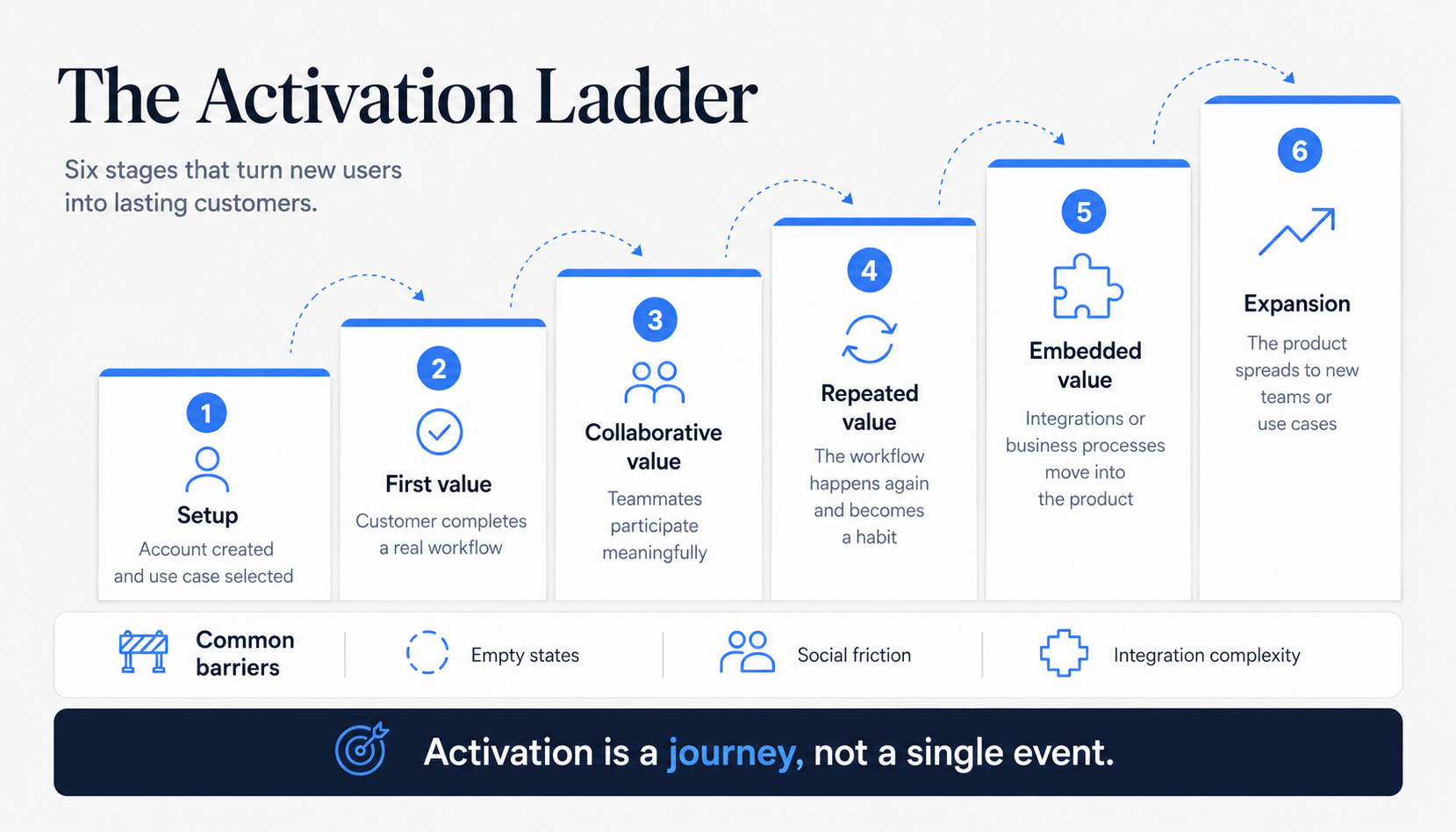
Activation is rarely one isolated moment. Most customers progress through several stages:
Setup
First value
Collaborative value
Repeated value
Embedded value
Expansion
The purpose of this ladder is not to create another complicated dashboard. It is to make the customer journey easier to diagnose.
If many customers complete setup but fail to reach the first value, the product may have an empty state or onboarding problem.
If customers reach first value but never collaborate, the problem may be sharing, permissions, or social friction.
If customers collaborate but do not repeat the workflow, the product may not be creating a strong enough habit or may lack recurring triggers.
Slack’s 2,000-message threshold represented a later point on this ladder. Teams had moved beyond setup and first use into collaborative, repeated, and increasingly embedded value
The four metrics that matter most
Once you define an activation threshold, begin with four metrics.
Activation rate: What percentage of qualified customers reach the milestone?
Time to activation: How long does it take them to get there?
Retention by activation status: Do activated customers actually retain at a higher rate?
Activation by segment: Which customer types, acquisition channels, use cases, or company sizes activate most successfully?
A useful primary operating metric might be:
Percentage of qualified new accounts that reach the activation threshold within fourteen days.
The purpose is not to maximize an isolated number. It is to increase the percentage of qualified customers who reach meaningful value and are subsequently retained.
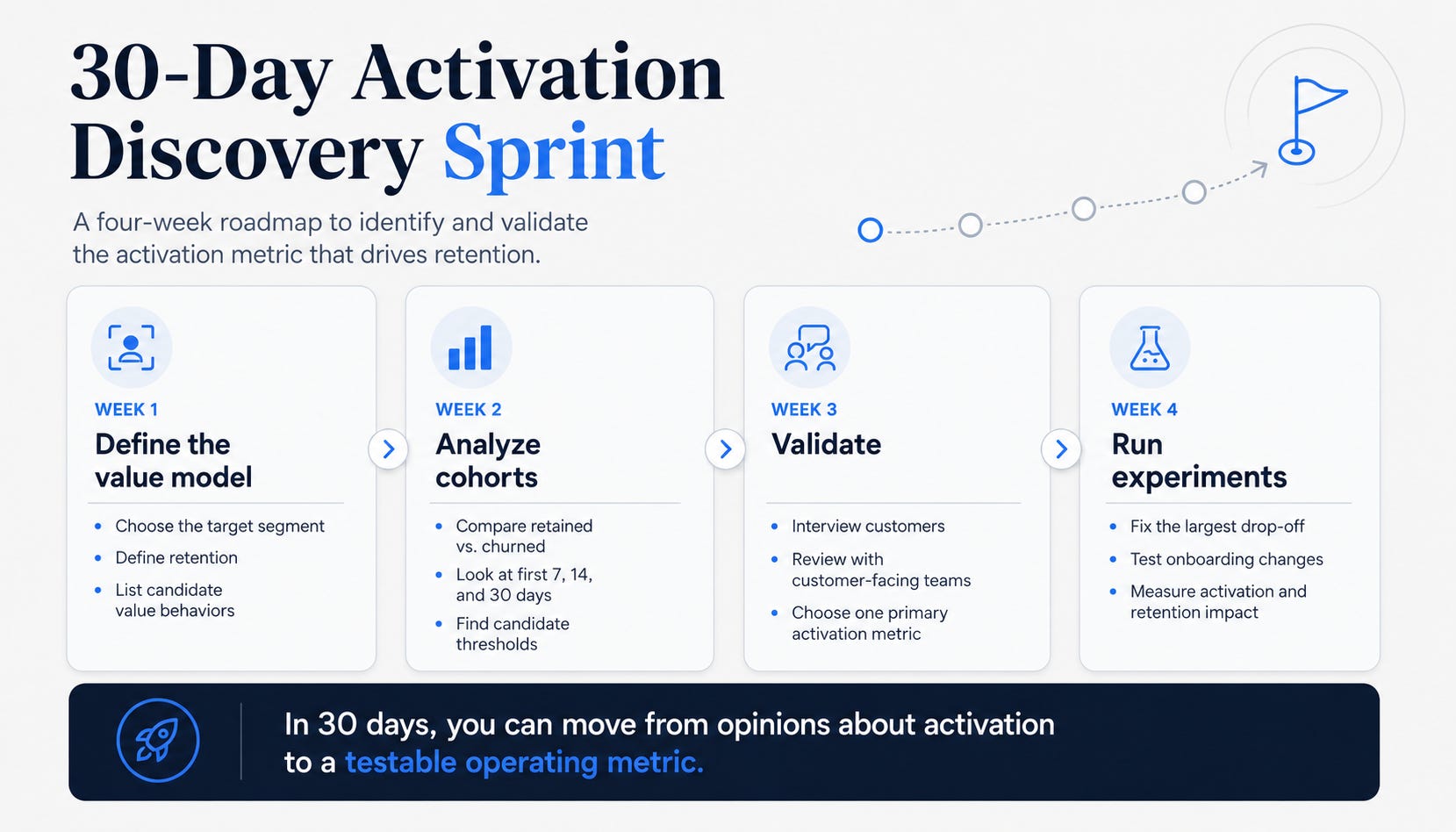
A 30-day activation discovery sprint
A team does not need a six-month transformation program to develop a useful first version of its activation model. A focused four-week sprint can create a strong starting point.
Week 1: Define the value model
Bring together product, data, growth, customer success, sales, and research.
Choose a target customer segment, define retention, and agree on the primary job customers hire the product to perform. Then list five to ten behaviors that could indicate meaningful value.
Do not debate the perfect metric yet. The goal is to create hypotheses.
Week 2: Analyze customer behavior
Compare retained, churned, converted, and expanded cohorts across the first 7, 14, and 30 days.
Study frequency, sequence, collaboration, and time to completion. Produce two or three candidate activation definitions rather than choosing one based on intuition.
For example:
Complete one workflow within seven days.
Complete three workflows within fourteen days.
Complete three workflows with two active teammates within fourteen days.
Week 3: Validate with customers and teams
Interview retained and churned customers.
Ask retained customers when the product first became genuinely useful and what changed in their workflow. Ask churned customers what they were trying to accomplish and where the experience failed to connect to a meaningful outcome.
Review the candidate metrics with customer-facing teams. Sales and customer success often observe adoption patterns that are not yet visible in the analytics.
Then select one primary activation metric and a small number of supporting milestones.
Week 4: Run one focused experiment
Identify the largest drop-off before activation and design one intervention around it.
That might mean replacing an empty state with a template, changing the timing of an invitation prompt, simplifying an integration, introducing a guided workflow, or triggering customer success outreach for high-value stalled accounts.
Measure both the immediate effect on activation and the later effect on retention.
Improving activation without improving downstream behavior may mean the team has optimized the metric rather than the customer outcome.
Common activation mistakes
The first mistake is copying another company’s metric. Slack’s threshold worked because messaging was Slack's core behavior. Your metric must reflect your own product’s value model.
The second is to choose the behavior with the strongest correlation, regardless of when it occurs. A highly predictive event that happens after six months may be useful for renewal forecasting but useless for onboarding.
The third is treating every customer as if they follow the same path. Enterprise accounts, small teams, administrators, practitioners, and different use cases may require different activation definitions.
The fourth is to decouple the activation metric from retention. Once teams are rewarded for improving a number, they may introduce prompts or defaults that increase activity without creating more value.
Finally, do not assume that more usage is always better. A customer may perform dozens of searches because the results are poor. A team may send more messages because communication has become fragmented.
The metric must represent progress toward the customer’s desired outcome, not simply increased product activity.
The real lesson from Slack
Slack grew because several parts of its product and business model reinforced one another. Teams could begin using it easily; coworkers created natural internal distribution; integrations brought more work into the product; and accumulated conversations made the workspace increasingly valuable.
The 2,000-message threshold gave Slack a way to understand when that system had started working for a customer.
That is the broader lesson for product-led companies.
Activation is not the moment someone creates an account. It is not the first interaction with a core feature, nor is it the onboarding event easiest to track.
Activation is the point at which customers have experienced enough repeated, meaningful value from the product to begin changing their behavior.
When a company can identify that point, product-led growth becomes much more practical. The team knows what onboarding should optimize, what lifecycle messaging should encourage, where customer success should intervene, and which accounts are genuinely progressing.
Most products already have their own version of Slack’s 2,000 messages.
The opportunity is to find it, validate it, and organize the customer journey around helping more customers reach it.